The World Before the Shock
For a quarter-century after the Second World War, the industrialized world ran on historically cheap energy. Crude oil at roughly $1.80 per barrel in 1970 dollars fueled the economic miracles of Western Europe and Japan, the suburbanization of the United States, and the explosive growth of automobile-dependent consumer economies. Between 1950 and 1972, global oil consumption tripled. The United States alone burned through roughly one-third of the world's output, and by the early 1970s was importing a growing share from the Middle East (Yergin, 1991).
American domestic oil production peaked in 1970, just as the geologist M. King Hubbert had predicted in 1956, and the country shifted from exporter to net importer. The Bretton Woods monetary order had anchored the dollar to gold and world currencies to the dollar, but by August 1971, President Nixon had severed that link, allowing the dollar to float and setting off a period of monetary instability. All the conditions for an oil shock were in place — though few in Western capitals recognized it.
OPEC, founded in 1960, had spent its first decade struggling for better terms from the multinational oil companies — the so-called Seven Sisters — that dominated production, pricing, and distribution. By the early 1970s, producing nations were asserting greater control through nationalization and participation agreements, and the balance of power was shifting. But the full implications would not be felt until war provided the catalyst.
The Yom Kippur War
October 6, 1973 — the Jewish holy day of Yom Kippur, during the Muslim holy month of Ramadan — Egyptian and Syrian forces launched a coordinated surprise attack on Israel. Egyptian troops crossed the Suez Canal and breached the Bar-Lev Line, the fortified Israeli defensive position in the Sinai. Simultaneously, Syrian armored columns stormed the Golan Heights, overwhelming the outnumbered Israeli defenders in the opening hours.
Israeli intelligence had received warnings but dismissed them. Egyptian bridgeheads across the canal held firm. Syrian tanks advanced deep into the Golan. For several days the outcome was genuinely uncertain, and Israel suffered its heaviest casualties since the 1948 War of Independence.
Mobilizing its reserves, Israel counterattacked on both fronts. On the Golan, Israeli forces halted the Syrian advance within three days and began pushing toward Damascus. In the Sinai, the situation remained precarious until October 15, when General Ariel Sharon led a daring crossing of the Suez Canal, cutting behind Egyptian lines and threatening to encircle Egypt's Third Army.
Both superpowers were deeply involved. Beginning October 14, the United States organized a massive airlift to Israel — Operation Nickel Grass delivered over 22,000 tons of military equipment. The Soviet Union supplied Egypt and Syria and reportedly placed airborne divisions on alert. For several tense days in late October, the crisis brought Washington and Moscow closer to direct confrontation than at any point since the Cuban Missile Crisis of 1962 (Garthoff, 1985).
A UN-brokered ceasefire took hold on October 22, though fighting sputtered on for several more days. Israel had reversed its early losses on the battlefield, but the political and economic consequences of the conflict would prove far more transformative than any military outcome.
The Oil Weapon
Eleven days after the war began, on October 17, 1973, the Organization of Arab Petroleum Exporting Countries (OAPEC) deployed oil as a geopolitical weapon. Member states agreed to cut production by 5% per month until Israel withdrew from territories occupied in 1967. Saudi Arabia — the world's largest exporter — cut production by 10%. A complete embargo was imposed on the United States and the Netherlands, the latter targeted because of its role as a major European oil-transshipment hub.
Timing amplified the impact enormously. World oil demand was already outrunning supply, and the spare production capacity that had cushioned disruptions throughout the 1960s had virtually disappeared. Even modest cuts in a tight market produced outsized price effects (Hamilton, 1983).
Posted prices told the story with brutal clarity. Arabian Light crude stood at $2.90 per barrel in September 1973. By October 16, it had jumped to $5.12. On December 22, OPEC ministers meeting in Tehran set the price at $11.65 — a quadrupling in less than three months. Spot market prices briefly exceeded $17 per barrel in January 1974.
Source: BP Statistical Review of World Energy; OPEC Annual Statistical Bulletin
Stagflation and the End of Cheap Energy
For industrialized economies that had built their postwar prosperity on cheap, abundant energy, the quadrupling of oil prices functioned as a massive tax imposed by foreign producers. Transportation, manufacturing, heating, petrochemicals, agriculture — every sector absorbed the blow simultaneously.
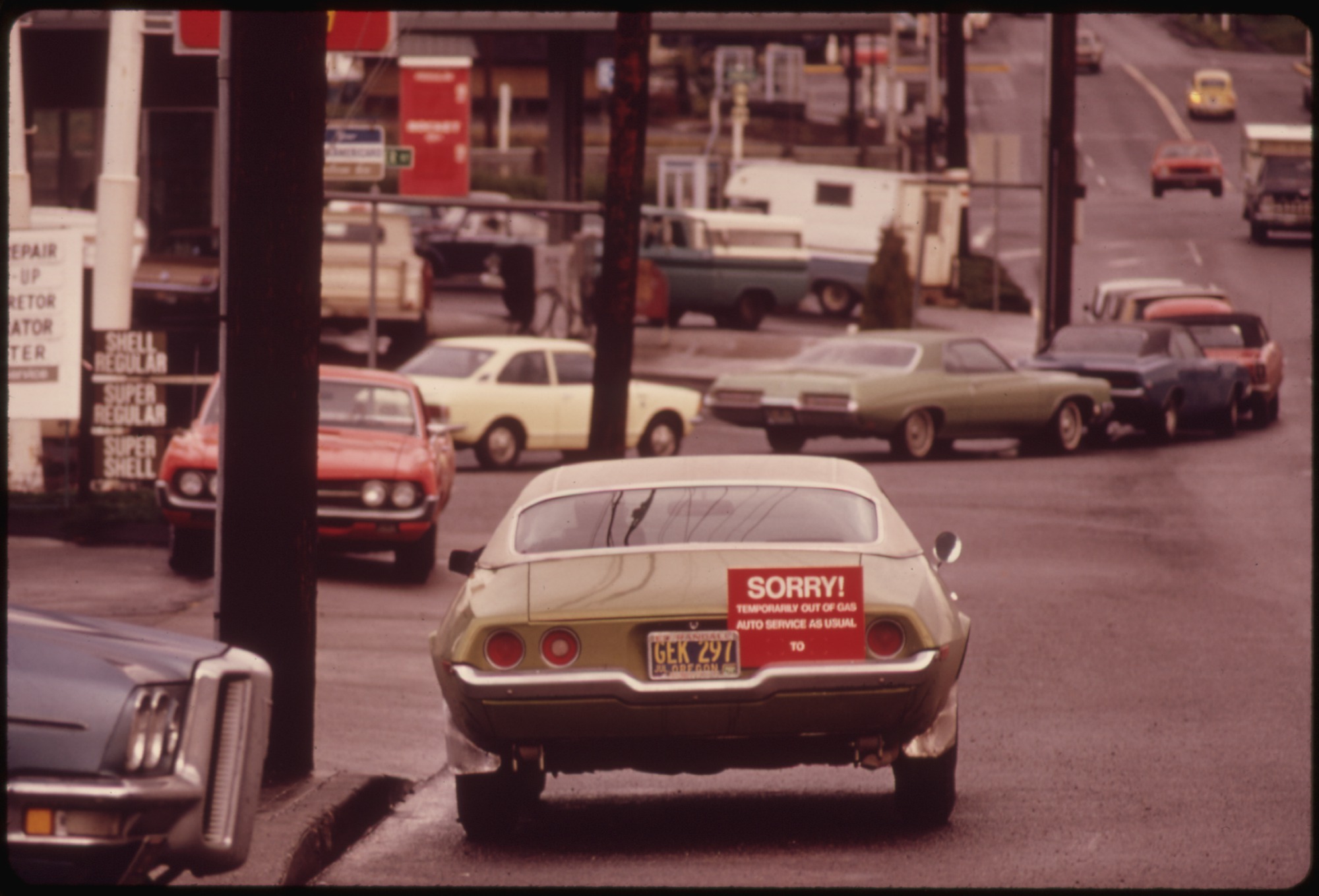
In the United States, the disruption was visceral. Gasoline shortages produced lines stretching for blocks at filling stations. Odd-even rationing schemes appeared, allowing motorists to buy fuel only on certain days depending on their license plate numbers. Nixon imposed a national speed limit of 55 miles per hour and ordered federal buildings to reduce heating. Daylight saving time was extended. The big American automobile — heavy, powerful, profligate with fuel — became an economic liability overnight (Barsky and Kilian, 2004).
Worse than the shortages was what they triggered in the broader economy: simultaneous inflation and recession, a combination Keynesian economics had no framework to explain. Economists coined a new term for it — stagflation. US consumer price inflation jumped from 3.4% in 1972 to 8.7% in 1973 and 12.3% in 1974. At the same time, real GDP contracted 0.5% in 1974 and unemployment climbed from 4.9% to 8.5% by 1975.
| Country | Stock Market Index | Peak-to-Trough Decline (1973-74) | CPI Inflation Peak | GDP Growth 1974 |
|---|---|---|---|---|
| United States | Dow Jones Industrial Average | -45% | 12.3% | -0.5% |
| United Kingdom | FTSE All-Share | -73% (real) | 24.2% | -1.4% |
| Japan | Nikkei 225 | -37% | 24.5% | -1.2% |
| West Germany | DAX | -32% | 7.0% | 0.2% |
| France | CAC General | -33% | 13.7% | 3.1% |
| Italy | MIB | -28% | 19.1% | 4.1% |
Britain, already weakened by industrial strife and structural economic problems, saw inflation reach 24.2% in 1975. Prime Minister Edward Heath imposed a three-day working week to conserve electricity after coal miners struck in sympathy with the oil crisis. Japan, which imported virtually all of its oil, experienced a traumatic "oil panic" that drove consumer prices up 24.5% in 1974 and produced the first GDP contraction since the war (Pempel, 1978).
The 1973-74 Bear Market
Equity markets were already vulnerable when the oil shock hit. US stock prices had peaked in January 1973 and had been drifting lower amid concerns about the end of the Bretton Woods system, the unfolding Watergate scandal, and rising inflation. The embargo turned an orderly correction into a rout.
From its January 1973 high of 1,051, the Dow Jones Industrial Average fell to 577 in December 1974 — a decline of approximately 45%. Adjusted for inflation, the real loss was closer to 56%. In inflation-adjusted terms, the bear market of 1973-74 rivaled the devastation that followed the 1929 crash, though stronger social safety nets and more active fiscal policy prevented the economic consequences from reaching Depression-era severity.
London fared worse. The UK stock market lost roughly 73% of its value in real terms between May 1972 and January 1975, hammered by the oil crisis, rampant inflation, the three-day week, and a secondary banking crisis. Japan's Nikkei 225 fell approximately 37% from its January 1973 peak, while markets across continental Europe suffered losses of 25% to 40%.
Among the casualties were the "Nifty Fifty" — the blue-chip growth stocks that institutional investors had treated as one-decision, buy-and-hold forever investments. Polaroid fell 91%. Avon Products dropped 86%. Xerox declined 71%. No valuation premium, it turned out, could insulate a stock from a macroeconomic shock of sufficient magnitude.
Petrodollars, Recycling, and the New Financial Order
Quadrupled oil prices produced a massive transfer of wealth from consuming to producing nations. OPEC revenues surged from approximately $23 billion in 1972 to $140 billion by 1977. Saudi Arabia, Kuwait, the UAE, and other Gulf states found themselves accumulating financial surpluses that far exceeded their ability to spend or invest domestically.
What to do with these "petrodollars" became one of the decade's defining financial challenges. The solution — emerging through a combination of market forces and diplomacy, most notably the 1974 US-Saudi agreement — was recycling. Oil revenues, denominated in dollars, were deposited in Western commercial banks and invested in US Treasury securities, real estate, and other financial assets. Those banks then lent the deposits to developing countries, particularly in Latin America — a process that sowed the seeds of the debt crises that would erupt in the 1980s.
Petrodollar recycling reinforced the dollar's role as the world's reserve currency at precisely the moment when the collapse of Bretton Woods had placed that status in doubt. Because oil was priced in dollars, every nation needed dollars to buy energy, creating structural demand for the American currency that persists to this day. Several Gulf states established sovereign wealth funds to manage accumulated wealth for future generations — notably the Kuwait Investment Authority, founded in 1953 but massively expanded after 1973, and the Abu Dhabi Investment Authority, established in 1976.
Bretton Woods Aftermath and Floating Rates
The oil shock accelerated a transformation of the international monetary system already underway since the collapse of Bretton Woods in August 1971. Massive balance-of-payments imbalances created by the oil price increase made fixed exchange rates untenable — oil-importing nations faced enormous trade deficits while exporters accumulated surpluses that overwhelmed the existing monetary framework.
Freed from its gold anchor, the dollar depreciated against major currencies in the early 1970s, and the oil shock intensified the slide. A vicious feedback loop emerged: as the dollar fell, OPEC members found their real revenues declining and pushed for further price increases to compensate. The Jamaica Accords of 1976 formally recognized the floating exchange rate system that had existed in practice since 1973, acknowledging that the era of managed parities was over.
The monetary instability of the 1970s would eventually produce the Volcker Shock of 1979-82, when the Federal Reserve raised interest rates to 20% to crush the inflation the oil crises had ignited. The entire decade between 1973 and 1983 can be understood as a single extended adjustment to the end of the postwar monetary and energy order.
Strategic Petroleum Reserves and Energy Security
The vulnerability the embargo exposed demanded an institutional response, and it came quickly. In November 1974, major oil-consuming nations established the International Energy Agency (IEA) as a counterweight to OPEC, tasked with coordinating emergency oil-sharing arrangements and promoting conservation. The United States created the Strategic Petroleum Reserve in 1975, eventually accumulating over 700 million barrels of crude oil stored in underground salt caverns along the Gulf of Mexico.
Energy policy, once a matter of economic management, became a question of national security. Governments invested in alternative energy sources, expanded nuclear power, and imposed efficiency standards. The corporate average fuel economy (CAFE) standards, enacted in 1975, mandated that American automakers double the fuel efficiency of their fleets — a regulation that fundamentally reshaped the automobile industry and opened the door to Japanese manufacturers whose smaller, more efficient cars matched the demands of the new landscape.
The crisis also ignited what development economists would later call the "resource curse." Oil-producing nations that received enormous windfalls often experienced not prosperity but political dysfunction, corruption, and economic distortion. Scholars such as Michael Ross and Terry Lynn Karl would formalize this as the paradox of plenty — the observation that resource wealth, far from guaranteeing development, can actively impede it. The money that flowed into the Middle East after 1973 financed both modernization and authoritarianism, with consequences still unfolding.
For modern portfolio managers navigating sector rotation, the 1973 oil shock remains a canonical example of how exogenous commodity shocks can reshape relative asset performance across sectors and geographies within weeks rather than quarters.
Legacy
October 1973 ended an era. Cheap energy and stable growth had defined Western prosperity since the late 1940s; the oil shock destroyed both assumptions simultaneously. Stagflation entered the macroeconomic vocabulary. Commodity markets proved they could be weaponized for geopolitical purposes. The transition from the Bretton Woods monetary order to the floating exchange rate regime that governs international finance today accelerated sharply.
Keynesian economics, already under strain from the Phillips curve breakdown, took a further blow from its inability to explain or treat simultaneous inflation and unemployment. Monetarist and supply-side alternatives gained adherents, reshaping economic policy for the next two decades. And the oil shock forced the industrialized world to confront an uncomfortable truth: the postwar boom had been built, in part, on cheap access to a finite resource concentrated in a politically volatile region. Half a century later, as energy transitions and geopolitical rivalries reshape markets once more, that dependence has changed in form but not in kind.
Related
Historical records Learn more about our methodology.