The Telegram From Philadelphia
Late on the morning of Sunday, 21 June 1970, lawyers for the Penn Central Transportation Company filed a petition for reorganization in the United States District Court for the Eastern District of Pennsylvania. The filing was made under Section 77 of the Bankruptcy Act, the special provision that governed the failure of railroad companies. With $4.6 billion in assets, Penn Central was — by a wide margin — the largest corporate failure in American history to that point. The press release announcing the filing was timed for a Sunday afternoon precisely so that markets would have a few hours to digest the news before opening on Monday. They did not digest it. They convulsed.
By Tuesday morning, dealers in the New York commercial paper market were quoting yields on top-tier paper roughly 100 basis points wider than the prior week. Paper that had traded at 8.0% on Friday could not be placed at 9.0% on Tuesday. Treasurers at industrial corporations who had assumed they could always roll their short-term obligations were calling their banks at six in the morning, asking whether their lines of credit would in fact be available if rollover failed. The wholesale funding market that had financed American corporate working capital for the better part of two decades had, in the space of forty-eight hours, stopped clearing.
What followed over the next seventy-two hours rewrote the role of the Federal Reserve. The action the Fed took on the night of 22 June and the morning of 23 June was, in technical terms, a routine adjustment of discount-window policy and Regulation Q ceilings. In substance, it was the first explicit post-1933 acknowledgement that the central bank stood as lender of last resort to the entire short-term funding market — not just to its member banks. Every modern episode in which the Fed has stepped into a market it does not regulate, from Continental Illinois in 1984 to the Commercial Paper Funding Facility of 2008 and 2020, descends from that decision (Brimmer, 1989).
Two Failing Railroads, One Bigger Failing Railroad
The Penn Central was the product of one of the most thoroughly studied corporate mergers in American business history. On 1 February 1968, after more than a decade of regulatory wrangling, the Pennsylvania Railroad and the New York Central Railroad combined to form the Penn Central Transportation Company. The Pennsylvania, headquartered in Philadelphia, had been the largest railroad in the United States by every conventional measure for most of the twentieth century. The New York Central, headquartered in Manhattan, had been its principal rival on the New York–Chicago corridor. Both were old, proud institutions. Both were dying.
The combined company controlled roughly 21,000 miles of track running through the most densely populated and industrialized region of North America. On paper, it should have been a powerhouse. In practice, the merger combined two declining freight businesses, two redundant route networks, two incompatible accounting systems, two warring management cultures, and two pension obligations that neither company could fund. The Pennsylvania men, conservative and operations-focused, regarded their New York Central counterparts as financial-engineering dilettantes. The New York Central men regarded the Pennsylvania men as plodding bureaucrats. The integration that was supposed to deliver $80 million per year of cost savings instead delivered open warfare in the executive corridors at Six Penn Center in Philadelphia (Daughen and Binzen, 1971).
Then came the New Haven. The New York, New Haven and Hartford Railroad — the dominant rail carrier of southern New England — had filed for bankruptcy in 1961 and never recovered. As a condition of approving the Penn Central merger, the Interstate Commerce Commission required the new company to absorb the New Haven on 1 January 1969. The New Haven brought with it 1,500 miles of decaying track, a fleet of obsolete passenger equipment, a heavily unionized workforce, and a passenger franchise that had not earned an operating profit since the Truman administration. Penn Central management, already drowning, was handed an anchor.
The numbers tell the rest. In 1968, its first full year, Penn Central reported $87 million in net income. In 1969 — its second year and the first to include the New Haven — it reported $4 million. In the first quarter of 1970, the company reported a $63 million loss. Cash from operations had turned negative the prior year and was deteriorating month by month. The board kept declaring dividends through May 1970 to avoid signalling distress. Stuart Saunders, the chairman, kept telling analysts that 1970 would be a turnaround year.
The Cash That Wasn't There
The most striking feature of Penn Central's financial reporting in the years before the bankruptcy is how thoroughly it concealed what was happening. Reported net income for 1968 and 1969 was supported by a mixture of accounting choices that, taken together, transformed a deeply cash-negative business into a marginally profitable one. Investment tax credits were recognized aggressively. Maintenance expenses were deferred. Capitalized interest was added back to income. Real-estate sale-leaseback transactions on parcels in midtown Manhattan and downtown Philadelphia generated reported gains while transferring the cash flow to outside lessors over decades.
David Bevan, the chief financial officer, was the architect of these techniques. He was also, simultaneously, the architect of Penn Central's funding strategy — and the funding strategy depended on the financial reporting. By the late 1960s the company could no longer issue investment-grade long-term bonds at acceptable yields. Bevan turned instead to the commercial paper market, where the issuer's credit was assessed on its most recent earnings statement and its commercial-bank backup lines, not on a careful examination of cash generation. As long as Penn Central could report net income, the paper would clear.
By the spring of 1970, Penn Central had roughly $200 million of unsecured commercial paper outstanding through the dealer Goldman Sachs. The buyers were a familiar institutional roster — bank trust departments, corporate cash managers, money-market funds in their early years, insurance companies. Few of them had performed independent credit analysis on the issuer. They had relied on the dealer's representation, on the Penn Central name, and on the implicit assumption that a railroad with $4 billion in assets could not possibly default on $200 million of short-term unsecured paper (Calomiris, 1994).
| Penn Central debt structure at filing, June 1970 ($ millions) | |
|---|---|
| Long-term first-mortgage bonds and equipment trust certificates | 1,800 |
| Other secured long-term debt | 600 |
| Bank loans (revolving and term) | 300 |
| Unsecured commercial paper outstanding | 200 |
| Trade payables and accrued expenses | 400 |
| Pension and post-retirement obligations | 700 |
| Other liabilities | 200 |
| Total liabilities (approximate) | 4,200 |
| Total reported assets | 4,600 |
The distress was not visible to a casual reader of the income statement. It was visible to anyone who tracked the cash. Bevan's own staff produced an internal cash-flow forecast in February 1970 that projected the company would run out of cash in the third quarter without external financing. That forecast was not shared with the board. It was not shared with the commercial paper buyers. It was not even shared, in full, with the company's lead bank, First National City Bank of New York.
Washington Says No
By April 1970, Penn Central's senior management had abandoned hope of solving the problem privately. Saunders authorized an extraordinary approach to the federal government — a request for a $200 million emergency loan guarantee under the Defense Production Act, on the rationale that the railroad's freight network was essential to military logistics. The request was routed through the Department of Transportation under Secretary John Volpe and the Treasury under Secretary David Kennedy, with political coordination by White House counsellor Bryce Harlow.
The internal debate inside the Nixon administration over the next six weeks was as candid as any in the historical record. Treasury opposed the guarantee on principle, arguing that bailing out a failing private railroad would create unmanageable precedent. The Department of Transportation supported it on national-security grounds. The Federal Reserve, consulted informally, was reluctant to comment on what it regarded as a fiscal rather than monetary question. The Office of Management and Budget under George Shultz raised the basic objection: the Penn Central's losses were structural, and a $200 million guarantee would simply postpone the failure by a few quarters at considerable cost to the taxpayer.
On 21 May 1970, the Senate Banking Committee held a closed hearing. Saunders made the case directly to the senators. The case was not persuasive. By early June the administration had concluded that no guarantee would be offered, and the message was passed to Penn Central's bankers in Philadelphia and New York that the company was on its own. Bevan made one last effort to syndicate a private rescue through the major money-centre banks. It failed by 19 June. The company's lawyers worked through the weekend on the bankruptcy petition.
The Monday Morning Freeze
What happened in the commercial paper market in the days after the filing is best described as a sudden disappearance of liquidity. The total volume of outstanding US commercial paper had grown roughly threefold over the previous five years, from about $10 billion at the start of 1965 to $33 billion by mid-1970. Most of that growth was in non-bank corporate paper, issued by industrial companies, finance subsidiaries of manufacturers, and a handful of railroads. Penn Central was not the largest issuer, but it was emblematic of the credit-blind expansion: its paper had been bought because it carried the Penn Central name, not because anyone had stress-tested its cash flows.
When the bankruptcy filing landed, every buyer in the market suddenly began asking the question they had not asked the prior week: what other issuers in our portfolio look like Penn Central? Money-market funds and bank trust departments began refusing to roll lower-tier paper. Yields on the strongest issuers — General Motors Acceptance Corporation, Ford Motor Credit, the major finance subsidiaries — widened by 50 to 70 basis points within forty-eight hours. Paper from second-tier issuers could not be placed at any reasonable yield. Roughly $3 billion in maturing paper that needed to be rolled over the following week could not be placed (Calomiris, 1994).
Source: Federal Reserve flow of funds, monthly outstandings
The buyers who could not roll their paper turned, en masse, to their commercial banks. The standard practice for a commercial paper issuer was to maintain bank lines of credit equal to one hundred percent of paper outstanding, drawable on demand, as an explicit backstop. In the calm of normal markets, the lines were never expected to be drawn. In the panic of late June 1970, every issuer drew them simultaneously. The major money-centre banks in New York, Chicago, and San Francisco were facing tens of billions of dollars in coordinated drawdowns from corporate clients, with no way to fund those drawdowns through the wholesale market — because the wholesale market was the same market that had just frozen.
Burns Opens the Window
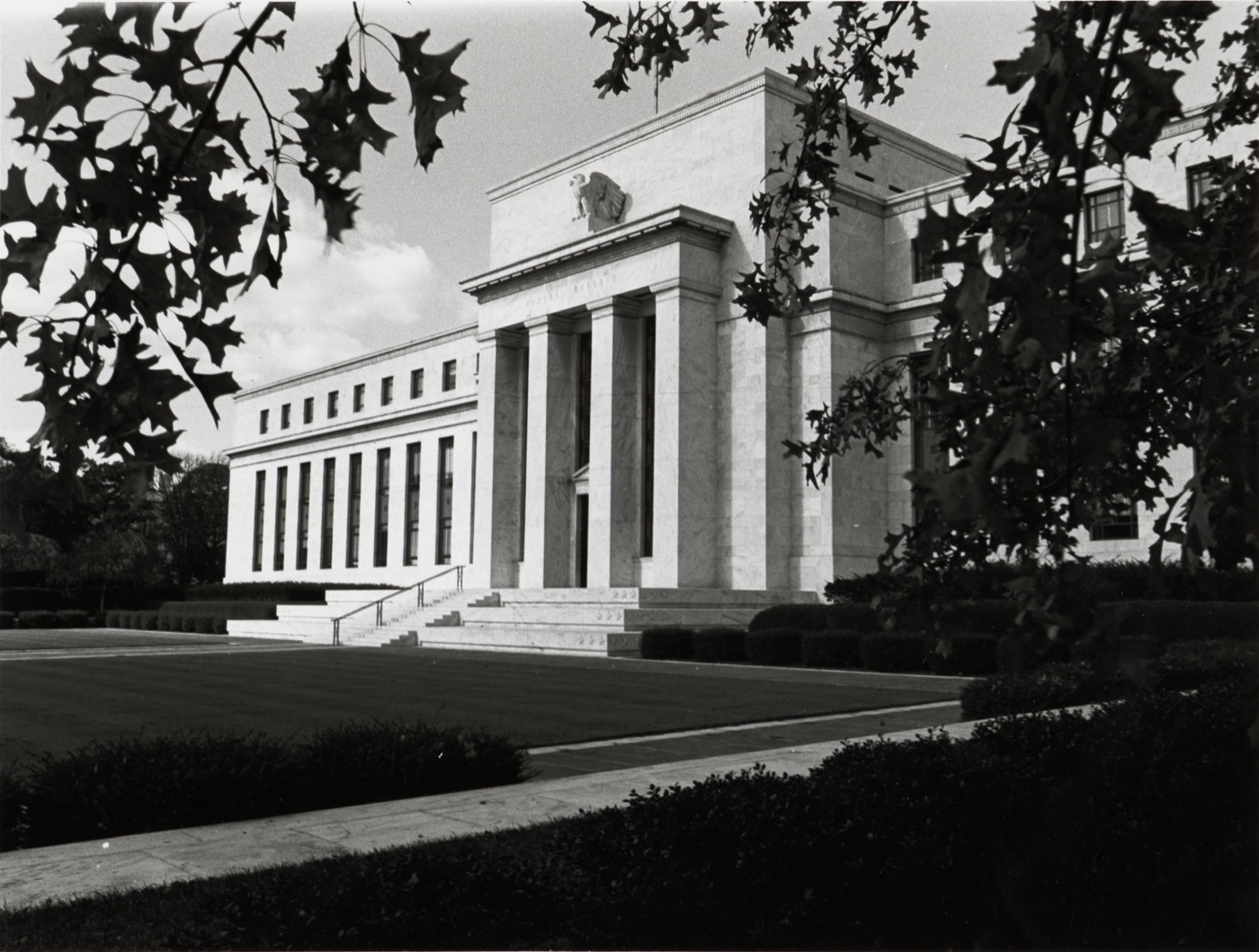
The Federal Reserve Board met on the evening of Monday, 22 June 1970, with Chairman Arthur Burns presiding. Burns, who had been confirmed only five months earlier and who would later record his recollections of the night in his private notes, understood immediately what was at stake. If the commercial paper freeze were allowed to run its course, the resulting wave of corporate liquidity failures would extend far beyond Penn Central. Industrial issuers with sound long-term prospects would default on short-term paper purely because no one would lend to them, banks would refuse to honour their backup lines because they could not fund the drawdowns, and the contagion would propagate through the corporate sector for months.
The decision was taken in two parts. First, the Federal Reserve Banks were instructed to make discount-window credit freely available to commercial banks specifically for the purpose of funding paper-rollover loans to corporate borrowers. The instruction was unusual not in its mechanics — the discount window had always been available to member banks — but in its target. The Fed was explicitly directing banks to use the window to support a market the Fed did not regulate, on behalf of borrowers the Fed had no formal relationship with. Second, the Board suspended the Regulation Q interest-rate ceiling on large negotiable certificates of deposit of $100,000 or more, which had previously prevented banks from bidding aggressively for replacement funding. The combination meant banks could borrow from the Fed at the discount rate or raise CDs in the market without an artificial cap, and lend freely to commercial-paper issuers (Burns, 1988).
| Federal Reserve emergency response, June 1970 | |
|---|---|
| Sun 21 June | Penn Central files Section 77 petition (afternoon) |
| Mon 22 June, AM | Commercial paper market opens with sharp yield widening; rollovers fail |
| Mon 22 June, PM | FRB meeting; Burns and Reserve Bank presidents agree on discount-window guidance |
| Tue 23 June, AM | FRB announces banks will be supplied at the discount window for paper-rollover loans |
| Tue 23 June, PM | Regulation Q ceiling on large CDs suspended |
| Wed 24 June | Banks draw approximately $1.7 billion from discount window in single day |
| Late June – mid July | Member-bank discount borrowing peaks above $1 billion outstanding |
| August 1970 | Commercial paper outstandings stabilize, yields normalize |
The market response was almost immediate. Banks drew approximately $1.7 billion from the discount window on Wednesday 24 June, the largest single-day discount borrowing on record at that time. Corporate paper rollovers that had failed on Monday and Tuesday could be replaced by drawn bank lines on Wednesday and Thursday. Yields on top-tier paper retraced about half of their move within ten days. By mid-August the market had stabilized, with total outstandings down only modestly from the pre-crisis peak. The contagion that could have brought down a long list of marginal industrial credits did not happen.
Andrew Brimmer's Phrase
The Federal Reserve Board governor Andrew Brimmer, who participated in the decisions of 22–23 June, gave a 1989 lecture in which he described the action in terms more candid than anything publicly stated at the time. Brimmer characterized the response as the moment the Fed acknowledged it had become "lender of last resort to the commercial paper market", and he linked it directly to the framework that Walter Bagehot had laid out for central bank crisis lending in 1873 — lend freely, against good collateral, at a penalty rate (Brimmer, 1989).
The phrase was significant because it acknowledged what officials had been reluctant to say in public: the discount window's purpose had always, in the Fed's own internal understanding, extended beyond direct lending to member banks. The authors of the Federal Reserve Act of 1913 had envisioned the central bank as a backstop to the broader credit system, with the banking sector as the conduit. What had been lost in the institutional caution following 1933 was the willingness to act on that mandate publicly. Penn Central forced the Fed to act, and, in acting, to acknowledge.
Conrail and the Reform of Commercial Paper
The political consequences of Penn Central unfolded over the next three years. The bankruptcy proceeding itself dragged on for nearly a decade, with the trustees discovering further accounting irregularities in the fall of 1970 and Bevan ultimately being prosecuted for securities-law violations. The Securities and Exchange Commission, which had been following Penn Central's filings without registering significant concerns, was harshly criticized in a 1972 staff report by William J. Casey for inadequate scrutiny.
The most lasting reform was structural. In 1973, Congress passed the Regional Rail Reorganization Act, which established the Consolidated Rail Corporation — Conrail — as a government-owned successor to take over the freight operations of Penn Central and six other bankrupt eastern railroads. Conrail began operations on 1 April 1976. It would be returned to the private sector through an initial public offering in 1987, and its eventual breakup between Norfolk Southern and CSX in 1999 was completed without a single hour of service interruption — a remarkable contrast with the chaos of the 1968 merger.
The commercial paper market reformed itself more gradually. The dealers — Goldman Sachs, Merrill Lynch, Salomon Brothers — instituted formal credit-analysis standards that had been absent before 1970. The major rating agencies, Moody's and Standard and Poor's, expanded their commercial paper ratings to cover virtually all issuers and began requiring full disclosure of bank backup lines. The buyers — money-market funds, in particular, which were entering their period of explosive growth — built credit-research staffs of their own. Most importantly, the unspoken assumption that "the name is good for the paper" was replaced by genuine credit assessment.
The Pattern That Repeats
Penn Central established a template that the Federal Reserve has reused in every major short-term funding crisis of the subsequent half-century. The mechanics vary; the logic does not. When wholesale funding markets seize because credit assessment has failed, the Fed opens the discount window, suspends or relaxes regulatory ceilings that constrain bank balance sheets, and channels liquidity through the banking system into the markets that have frozen.
The pattern recurred with Continental Illinois in 1984, where the discount-window peak loan to a single institution reached $3.5 billion. It recurred in 1987 after the October crash, when Alan Greenspan's one-sentence statement — a commitment to provide liquidity to the financial system — was modeled on the Burns precedent. It recurred in spectacular form during the 2008 financial crisis, when the Reserve Primary Fund's "breaking the buck" on 16 September 2008 triggered a money-market run of a kind that the post-Penn-Central reforms had been specifically designed to prevent. The Fed's response in 2008 — the Money Market Investor Funding Facility, the Asset-Backed Commercial Paper Money Market Mutual Fund Liquidity Facility, the Commercial Paper Funding Facility — were direct lineal descendants of Burns's discount-window guidance from June 1970, executed with vastly more legal and operational machinery but identical in purpose.
The Commercial Paper Funding Facility was relaunched on 17 March 2020 as the COVID-19 shock froze short-term funding for the second time in a generation. Within seventy-two hours of its activation, commercial paper yields retraced most of their move and the market resumed clearing. The Fed had become so practised at the manoeuvre that the relaunch was almost routine.
What Saunders Said in Court
Stuart Saunders was deposed in 1971 as part of the bankruptcy proceedings. Asked by the trustees' counsel why the company had continued issuing commercial paper through the spring of 1970 when its internal cash-flow forecasts predicted insolvency, Saunders gave an answer that has been quoted in nearly every subsequent treatment of the case. "The alternative," he said, "was to stop issuing the paper. And if we had stopped issuing the paper, we would have failed three months earlier." Penn Central, in other words, had been kept alive by the very market mechanism that its failure ultimately froze. The buyers funded the company because they did not understand it, and the company depended on their misunderstanding.
The decision Arthur Burns and his colleagues took on the night of 22 June 1970 — to use the discount window as the relief valve for a market panic among issuers the Fed did not regulate — was, in retrospect, not radical. It was an admission of a fact that had been true since the 1913 Act and that had simply been left undeclared for thirty-seven years. The central bank stands behind the short-term funding system. When the system seizes, the central bank acts. Every subsequent generation of policymakers has inherited that admission, refined the tools used to act on it, and, in private moments, occasionally wished they could put it back in the box.
The box has not closed since.
Related
Historical records Learn more about our methodology.