The World in Ruins
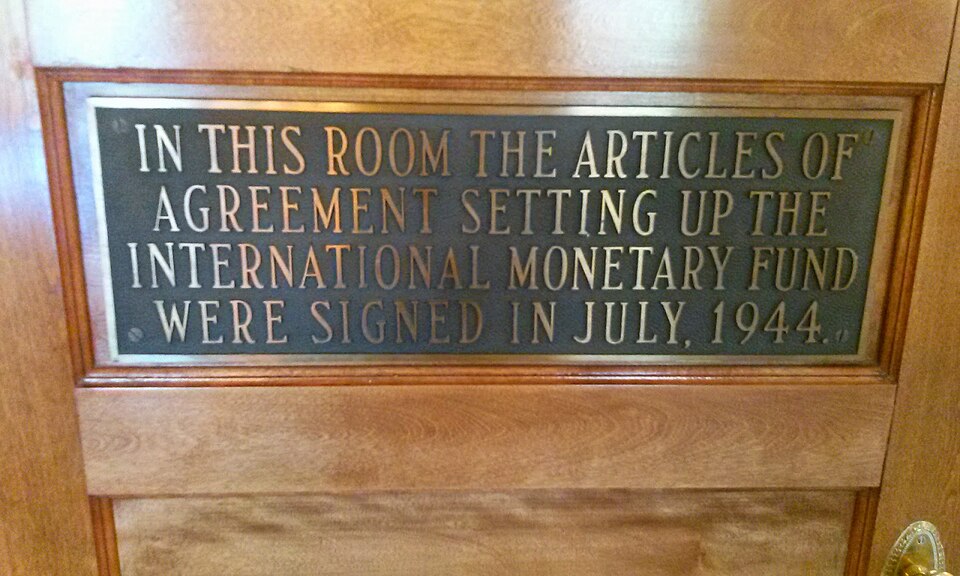
In July 1944, while Allied armies fought their way through the hedgerows of Normandy, 730 delegates from 44 nations checked into the Mount Washington Hotel in Bretton Woods, New Hampshire. Their mission was not military but economic: to design the monetary architecture of the post-war world. Everyone present understood what was at stake. Competitive currency devaluations, trade wars, the collapse of the gold standard, and the Great Depression had fed directly into the rise of fascism and the deadliest conflict in human history. No one wanted to build that world again.
Two intellectual giants dominated the conference. John Maynard Keynes — by then the most famous economist alive, though visibly ailing from the heart disease that would kill him two years later — represented a Britain that was financially exhausted and deeply indebted to its American ally. Harry Dexter White, an intense, chain-smoking Treasury official, represented the United States. Their visions for the post-war monetary order diverged sharply, but both men shared an unshakeable conviction: stable exchange rates and open international trade were preconditions for lasting peace.
Keynes vs. White
Keynes arrived with the more ambitious plan. His proposed International Clearing Union would issue its own reserve currency — the bancor — and, critically, would pressure surplus countries to adjust just as much as deficit countries, preventing the deflationary bias that had crippled the gold standard in the 1930s. Under Keynes's scheme, no single nation's currency would dominate; the monetary order would be genuinely multilateral.
White's plan was narrower, harder-edged, and aligned with American interests. Member nations would contribute gold and currency to a stabilization fund that could lend to countries facing temporary balance-of-payments difficulties. Exchange rates would be fixed but adjustable, pegged to the US dollar, which would itself be convertible to gold at $35 per troy ounce. The anchor of the system would not be a supranational currency but the dollar — and through the dollar, American economic power.
White's plan prevailed, and the reason was simple arithmetic. In 1944, the United States produced roughly half the world's industrial output, held two-thirds of the world's monetary gold reserves, and was the only major economy to emerge from the war with its factories intact. Keynes, representing a nation that owed billions to Washington, was in no position to impose his vision. He described the negotiations with characteristic wit: the Americans offered suggestions, and the British were permitted to agree.
Three Pillars
Bretton Woods rested on three institutional pillars. First came a system of fixed exchange rates: each member country declared a par value for its currency in terms of gold or the US dollar and committed to holding market rates within 1 percent of parity. Washington, in turn, pledged to convert foreign official dollar holdings into gold at $35 per ounce on demand.
Second, the International Monetary Fund would oversee the system and provide short-term financing to countries experiencing balance-of-payments trouble. Each member contributed a quota of gold and domestic currency, against which it could borrow. The IMF was designed to give countries breathing room — time to adjust gradually rather than being forced into the sudden, deflationary corrections that had proved so catastrophic in the interwar years.
Third, the International Bank for Reconstruction and Development — later known as the World Bank — would provide long-term lending for post-war rebuilding and, eventually, economic development in poorer nations.
| Institution | Purpose | Initial Capital |
|---|---|---|
| IMF | Exchange rate stability, short-term balance-of-payments lending | $8.8 billion in quotas |
| World Bank (IBRD) | Long-term reconstruction and development lending | $10 billion authorized |
| GATT (1947) | Trade liberalization (not part of Bretton Woods but complementary) | N/A |
A Golden Age
Supplemented by the Marshall Plan — $13.3 billion in aid to Western Europe between 1948 and 1952 — and the General Agreement on Tariffs and Trade, the Bretton Woods system provided the monetary framework for what economic historians often call the Golden Age of Capitalism. Between 1950 and 1973, the advanced industrial economies grew at rates never seen before or since.
Real GDP per capita in Western Europe rose at an average annual rate of 4.1 percent during those years, compared to 1.3 percent in the turbulent decades from 1913 to 1950. Japan's growth was even more dramatic, averaging 8.1 percent per year. World trade expanded at roughly 7 percent annually — three times faster than in any previous era. Unemployment in the major industrial economies rarely exceeded 3 percent, and the war-devastated economies of Europe and Japan steadily closed the productivity gap with the United States in an era of broad convergence.
Source: US gold reserves in billions of dollars, from Federal Reserve historical data
Fixed exchange rates were both a cause and a consequence of this growth. Businesses could plan long-term investments without hedging against currency fluctuations, and the dollar's role as anchor currency gave the United States what French finance minister Valery Giscard d'Estaing memorably called an "exorbitant privilege" — the ability to borrow abroad in its own currency and run persistent balance-of-payments deficits that would have forced any other country to devalue.
The Triffin Dilemma
Belgian-American economist Robert Triffin identified the system's fatal contradiction in 1960. For the global economy to grow, the world needed a steadily expanding supply of dollars to lubricate trade and fill central bank reserves. But the only way to put those dollars into foreign hands was for the United States to run balance-of-payments deficits. As dollar claims accumulated abroad, they would eventually exceed the American gold stock, undermining confidence in the dollar's convertibility. The system required American deficits to function and would be destroyed by the consequences of those deficits.
By the early 1960s, Triffin's paradox was moving from theory to reality. Foreign central banks — particularly the Banque de France under President Charles de Gaulle — began converting dollar holdings into gold at the $35-per-ounce rate, draining American reserves. De Gaulle made no secret of his contempt for what he called America's abuse of the dollar's privilege, publicly advocating a return to the classical gold standard in a 1965 press conference that sent shockwaves through currency markets. Between 1958 and 1971, US gold reserves fell from $20.6 billion to $10.2 billion, while foreign official dollar claims swelled past $50 billion.
Washington tried various measures to defend the peg without addressing the underlying imbalances. The London Gold Pool — a consortium of central banks formed in 1961 — intervened in the gold market to suppress prices. Capital controls were imposed to stem the outflow of dollars. The Interest Equalization Tax of 1963 sought to discourage American investment abroad. Each measure was palliative rather than curative, and each created distortions of its own — a pattern familiar to anyone who has studied how tail risks accumulate in supposedly stable systems.
The Nixon Shock
By 1971, the situation had become untenable. Vietnam War spending and President Lyndon Johnson's Great Society programs had expanded the federal budget without corresponding tax increases, generating inflationary pressures that further eroded confidence in the dollar. Britain had devalued the pound in 1967; France had devalued the franc in 1969. Speculative attacks against the dollar intensified through the spring and summer.
On the weekend of August 13-15, 1971, President Richard Nixon convened a secret meeting of his top economic advisors at Camp David. Treasury Secretary John Connally — a forceful Texan who had been sitting in the car next to John F. Kennedy in Dallas and who had little patience for the niceties of international monetary diplomacy — pressed for dramatic unilateral action. On the evening of August 15, Nixon appeared on national television and announced what the world would come to call the Nixon Shock: the United States was suspending the convertibility of the dollar into gold, imposing a 10 percent surcharge on imports, and instituting a 90-day wage and price freeze.
Nixon presented the measures as temporary. The gold window never reopened. The Smithsonian Agreement of December 1971 attempted to salvage fixed rates by devaluing the dollar to $38 per ounce and widening the permissible fluctuation bands, but that arrangement lasted barely fourteen months. By March 1973, the major currencies were floating freely against each other. Twenty-seven years after Bretton Woods, the system Keynes and White had built was gone.
What Remained
Floating exchange rates brought greater currency volatility, periodic crises — including the Asian Financial Crisis of 1997 — and new challenges to monetary stability. The IMF and World Bank outlived the system that created them, evolving into institutions focused on development lending and crisis management in emerging markets. The dollar, despite losing its gold anchor, remained the world's dominant reserve currency, though its primacy has faced mounting questions in the decades since.
What Bretton Woods demonstrated, during the quarter-century it functioned, was that deliberate institutional design could create conditions for broadly shared prosperity on an unprecedented scale. Its collapse demonstrated something equally important: no monetary system is permanent, and the tension between national sovereignty and international monetary cooperation cannot be resolved — only managed, renegotiated, and managed again. Keynes, who died in April 1946 before the system he had helped build was fully operational, might have appreciated the irony. He had always insisted that economics was not a science of eternal laws but a discipline shaped by the messy, contingent realities of politics and power. Bretton Woods proved him right — first in its success, then in its unraveling.
Related
Historical records Learn more about our methodology.