A Rothschild Bank in the Heart of Europe
On a spring morning in May 1931, the directors of Austria's largest financial institution gathered to confront a truth they had spent months concealing. Creditanstalt — the bank that Anselm von Rothschild had founded in 1855, the institution that financed the railroads and factories of the Habsburg Empire, the pillar on which two-thirds of Austrian industry rested — was insolvent. Its losses exceeded 140 million Austrian schillings, more than its entire share capital. Within weeks, that insolvency would detonate a chain reaction of bank failures stretching from Vienna to Berlin to London, shattering the international gold standard and transforming what had been a painful but manageable recession into the defining economic catastrophe of the twentieth century.
No single bank failure in modern history has carried consequences so vast. Creditanstalt did not merely collapse — it pulled the foundations out from under the entire European financial order.
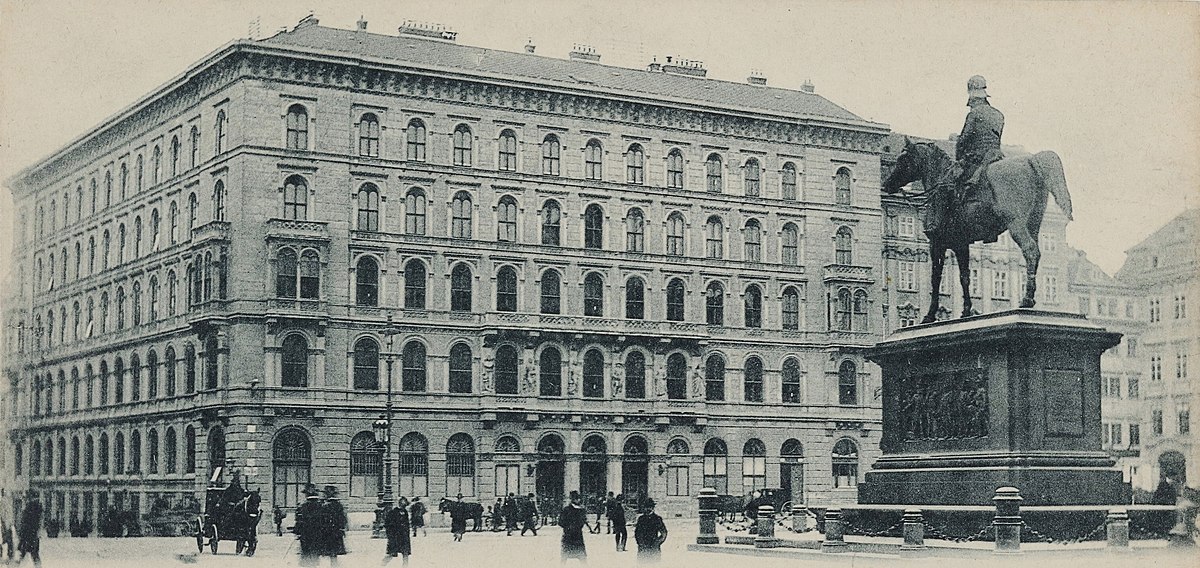
Origins: The Rothschild Bank and the Habsburg Economy
Creditanstalt-Bankverein was established in Vienna in 1855 by Anselm von Rothschild, son of Salomon Rothschild, who had built the Austrian branch of the Rothschild banking dynasty. From its inception, the bank operated as a universal bank in the continental European tradition — combining deposit-taking, commercial lending, and direct equity stakes in industrial enterprises on a single balance sheet. It financed Austria's railway expansion, underwrote government bonds, and acquired controlling interests in steelworks, textile mills, sugar refineries, and machine manufacturers across the Habsburg lands.
By the early twentieth century, Creditanstalt had become the financial backbone of the Austro-Hungarian Empire. Its branch network stretched from Prague to Budapest to Trieste, and its industrial portfolio made it less a bank than a conglomerate with a banking license. This model delivered enormous profits during the decades of Habsburg stability. It would prove catastrophic when that stability vanished.
The Rump State: Austria After the Habsburgs
Everything changed with the collapse of the Austro-Hungarian Empire in 1918. The Treaty of Saint-Germain in 1919 carved the empire into successor states — Czechoslovakia, Hungary, Yugoslavia, Poland — leaving Austria as a small, landlocked republic of 6.5 million people. Vienna, a capital built to govern 52 million, now presided over an alpine rump state with a fraction of its former economic hinterland.
For Creditanstalt, the consequences were severe. Factories it had financed now sat behind foreign borders. Trade routes that had once connected a unified economic zone were fractured by tariff walls. Markets that Austrian industry had served for generations were suddenly the territory of rival national economies. The bank's industrial portfolio, built for an empire, was stranded in a country too small to sustain it.
Austria struggled through the 1920s with chronic fiscal deficits, persistent unemployment, and an economy that never fully recovered from the war. A League of Nations stabilization loan in 1922 averted immediate fiscal collapse and established the Austrian schilling on the gold standard, but the underlying structural weakness remained. Vienna's banking sector was vastly oversized for the diminished republic — a financial system designed for a great power, trapped in a minor state (Schubert, 1991).
The Fatal Merger of 1929
Creditanstalt's trajectory turned decisively in October 1929, when the Austrian government pressured the bank into absorbing Bodenkreditanstalt, the country's second-largest bank, which had itself taken over several smaller failing institutions. Bodenkreditanstalt was already deeply impaired, its portfolio loaded with non-performing loans to struggling industrial firms. The merger was not a commercial decision — it was a political one. Austrian authorities, terrified of a banking panic, forced Creditanstalt to swallow an institution whose liabilities far exceeded its assets.
Louis von Rothschild, the head of the Austrian Rothschild family and Creditanstalt's principal shareholder, opposed the merger. He understood that absorbing Bodenkreditanstalt's toxic portfolio would critically weaken the bank. But political pressure prevailed. The government and the Austrian National Bank assured the Rothschilds that the state would stand behind any resulting losses. Those assurances would prove hollow.
| Event | Date | Consequence |
|---|---|---|
| Creditanstalt founded by Rothschild family | 1855 | Becomes Austria's dominant universal bank |
| Collapse of Austro-Hungarian Empire | 1918 | Loss of economic hinterland |
| Treaty of Saint-Germain | 1919 | Austria reduced to rump state of 6.5 million |
| League of Nations stabilization loan | 1922 | Austria pegged to gold standard |
| Forced merger with Bodenkreditanstalt | October 1929 | Absorption of toxic industrial assets |
| Announcement of 140 million schilling losses | 11 May 1931 | Triggers European banking crisis |
| German banking crisis (Danatbank) | July 1931 | Contagion spreads to Berlin |
| Britain abandons gold standard | 21 September 1931 | Sterling devaluation; end of gold-standard era |
11 May 1931: The Announcement
On 11 May 1931, the Austrian government publicly announced that Creditanstalt had reported losses of 140 million schillings — a figure that represented the entirety of the bank's share capital and half its reserves. The true losses, investigators would later discover, were substantially larger. Years of declining asset values, concealed through creative accounting and government complicity, had hollowed out the institution from within (Kindleberger, 1973).
The Austrian government immediately guaranteed all of Creditanstalt's deposits and foreign liabilities. But the guarantee itself became a source of alarm. If Austria's largest bank required a government bailout, what did that say about the country's other financial institutions? What did it say about the government's own fiscal position? Depositors — both domestic and foreign — began withdrawing funds not just from Creditanstalt but from every Austrian bank. Foreign creditors, many of them British and American institutions that had extended short-term loans to Vienna's banking sector, demanded repayment.
Within days, Austria's gold and foreign exchange reserves began hemorrhaging. The Austrian National Bank lost nearly a third of its reserves in the first three weeks after the announcement. Here the gold standard revealed itself as a straitjacket rather than a shield. To defend the schilling's gold convertibility, Austria needed to maintain adequate reserves — but maintaining those reserves meant refusing to print the money that the banking system desperately needed. Rescuing the banks required abandoning the currency peg; defending the currency peg meant letting the banks die.
The Gold Standard Trap
Austria was not alone in this dilemma. Every country on the gold standard faced the same impossible choice when a banking crisis struck. Central banks could not act as lenders of last resort — flooding the financial system with liquidity — without risking a run on their gold reserves and a collapse of their exchange rate. The gold standard, designed to provide monetary stability, instead became the primary mechanism through which local banking panics transmitted into international financial crises (Eichengreen, 1992).
The Austrian National Bank chose to defend the schilling. It raised interest rates, restricted credit, and appealed to foreign central banks for emergency loans. The Bank of England and the Bank for International Settlements extended short-term credits totaling 150 million schillings. It was not enough. Gold continued to drain from Vienna.
France held the key. The Banque de France possessed the largest gold reserves in continental Europe and could have provided the emergency lending that would have stopped the panic. But French officials attached a devastating political condition to any loan: Austria must abandon its proposed customs union with Germany, a project that France viewed as a precursor to the political unification expressly forbidden by the Treaty of Versailles. For weeks, negotiations dragged on while the crisis deepened. By the time a partial agreement was reached, the contagion had already jumped Austria's borders.
Contagion: From Vienna to Berlin to London
Germany was the next domino. German banks had extensive exposure to Austrian institutions, and their own balance sheets were weakened by the same post-war dislocation that afflicted Austria. As news of Creditanstalt's collapse spread, foreign creditors began pulling short-term loans from German banks with the same urgency they had shown in Vienna.
On 13 July 1931, Danatbank — one of Germany's four great banks — closed its doors after failing to meet withdrawal demands. Dresdner Bank teetered on the edge. The German government declared a two-day bank holiday, froze foreign exchange transactions, and imposed capital controls. It was the most severe banking crisis in German history, and it came barely a decade after the country had endured the Weimar hyperinflation that had already destroyed faith in financial institutions once.
President Herbert Hoover attempted to stem the bleeding with a one-year moratorium on all intergovernmental war debts and reparation payments, announced on 20 June 1931. The Hoover Moratorium provided a moment of psychological relief, but it came too late to halt the cascade. The fundamental problem — a banking system drained of liquidity within a monetary framework that prevented emergency lending — remained untouched.
Britain fell next. Sterling had been under pressure throughout the summer as foreign holders liquidated London assets to cover losses elsewhere. On 21 September 1931, Britain abandoned the gold standard, allowing the pound to float. It was a seismic event. Sterling had been the anchor of international finance for over a century; its departure from gold signaled the effective end of the interwar gold standard system. Within months, more than two dozen countries followed Britain off gold.
The Failure of International Cooperation
What made the Creditanstalt crisis so destructive was not the size of the bank's losses — in absolute terms, they were modest compared to the financial system as a whole. It was the failure of international cooperation at every critical juncture. France used the crisis as diplomatic leverage, demanding political concessions in exchange for financial assistance. Britain lacked the reserves to lead a rescue. The United States, the world's largest creditor nation, remained paralyzed by domestic political constraints and a Federal Reserve that misunderstood the severity of the crisis.
There was no international lender of last resort. No institution existed with the authority and resources to flood the system with liquidity, guarantee cross-border deposits, or coordinate a synchronized response. Each country fought the crisis alone, and each country's defensive measures — capital controls, credit restrictions, competitive devaluations — made the crisis worse for its neighbors. Beggar-thy-neighbor became the reigning doctrine of international finance (James, 2001).
From Banking Crisis to Great Depression
The collapse of the European banking system in the summer of 1931 marked the inflection point at which a severe economic downturn became the Great Depression. Before Creditanstalt's failure, the global economy was in recession — industrial production had fallen, unemployment had risen, commodity prices had declined sharply since the 1929 crash. But the contraction, while painful, had not yet reached the catastrophic dimensions that would define the Depression.
After the summer of 1931, everything accelerated. Credit froze across Europe. International lending, which had sustained the fragile post-war recovery, collapsed almost entirely. Trade volumes plummeted as countries retreated behind tariff walls and exchange controls. Industrial production in Germany fell by over 40 percent between 1929 and 1932. Austrian unemployment reached 26 percent. Britain's departure from gold forced a wave of competitive devaluations that disrupted trade patterns worldwide.
In the United States, the European banking crisis intensified domestic financial stress. American banks that had lent to European institutions suffered losses. Depositors who read about bank failures abroad grew nervous about their own banks. The second and third waves of American bank failures — in late 1931 and early 1933 — owed much to the contagion that had originated in Vienna five months earlier. The regulatory response in America ultimately produced the Glass-Steagall Act of 1933, which separated commercial and investment banking in a direct attempt to prevent the kind of universal banking model that had made Creditanstalt so dangerous.
The Rothschild Family's Reckoning
For the Rothschild family, Creditanstalt's collapse was both a financial and a personal catastrophe. Louis von Rothschild, as the bank's principal shareholder, bore enormous personal liability. He poured family resources into covering the bank's losses, but the scale of destruction far exceeded what any private fortune could absorb. The Austrian branch of the Rothschild dynasty — which had operated continuously in Vienna since the Napoleonic era — saw its wealth devastated.
The political consequences proved even grimmer. Austria's economic collapse fueled the rise of extremist movements. When Nazi Germany annexed Austria in March 1938, Louis von Rothschild was arrested and held for over a year. His release was secured only after the family agreed to surrender its remaining Austrian assets — palaces, art collections, industrial holdings — to the Nazi regime. The Creditanstalt building itself became an instrument of the regime's financial administration. A bank founded to build an empire's economy ended as plunder for those who destroyed it.
Lessons That Echo
Creditanstalt's story carries lessons that resonate far beyond 1931. First, the universal banking model — in which a single institution serves simultaneously as deposit-taker, commercial lender, and industrial investor — concentrates risk to a degree that can render an entire economy hostage to one balance sheet. When Creditanstalt failed, it did not merely leave depositors unprotected; it threatened the viability of every major Austrian industrial enterprise. The separation of commercial and investment banking that followed in the United States and elsewhere was a direct response to this danger.
Second, the gold standard acted as a crisis amplifier rather than a crisis buffer. By preventing central banks from expanding the money supply during a banking panic, it ensured that local liquidity crises escalated into international solvency crises. Every modern central banker who has authorized emergency lending during a financial crisis — from the Bank of Japan in the 1990s to the Federal Reserve and European Central Bank in 2008 — has been acting on lessons first taught by Creditanstalt's collapse.
Third, the absence of international coordination turned a manageable crisis into an unmanageable one. France's insistence on extracting political concessions, Britain's inability to lead, America's isolationism — each compounded the damage. The post-World War II institutions that now form the backbone of international financial cooperation — the International Monetary Fund, the World Bank, the network of central bank swap lines — were designed specifically to prevent a repeat of 1931's catastrophic coordination failure.
The Lehman Parallel
Seventy-seven years after Creditanstalt's failure, Lehman Brothers collapsed on 15 September 2008, and the parallels were striking. Both were large, interconnected financial institutions whose failure exposed the fragility of the broader system. Both triggered a cascade of counterparty fear that froze credit markets worldwide. Both revealed that regulators had underestimated the systemic importance of a single institution. And in both cases, the failure of authorities to organize a timely rescue — whether due to political conditions attached to aid (as in 1931) or ideological reluctance to bail out a private firm (as in 2008) — transformed a contained crisis into a global catastrophe.
There was one critical difference. In 2008, central banks eventually responded with overwhelming force — slashing interest rates to zero, purchasing trillions in government bonds, and opening unlimited swap lines between major central banks. They could do this because the world had abandoned the gold standard. In 1931, no such response was possible. The gold standard tied the hands of every central banker in Europe, and the crisis that began with one Austrian bank proceeded, unchecked, to engulf the world.
Creditanstalt's marble halls in Vienna still stand on the Schottengasse, now housing a successor institution under a different name. The building endures, but the financial order it once anchored lies buried beneath nearly a century of reform, crisis, and reconstruction — a monument to what happens when a system built on rigid rules meets a shock that demands flexibility, and the rules win.
Related
Historical records Learn more about our methodology.