The Canal That Built an Empire
On 26 July 1956, Gamal Abdel Nasser stood before a crowd in Alexandria and delivered a speech that would detonate the final crisis of the British Empire. Egypt was nationalising the Suez Canal Company. The waterway that connected the Mediterranean to the Red Sea, that carried two-thirds of Europe's oil, that had been the jugular vein of British imperial commerce for nearly a century — it now belonged to Egypt.
In London, the reaction was visceral. Prime Minister Anthony Eden, a patrician diplomat who had spent his career in the shadow of great-power politics, received the news during a dinner at 10 Downing Street. He turned white. Within hours, he had convened an emergency cabinet session and begun comparing Nasser to Mussolini. The analogy was telling. Eden had been among those who opposed appeasement in the 1930s, and he was determined not to repeat what he saw as the mistakes of Munich. Nasser had to be stopped — by force if necessary.
What Eden did not fully grasp was that the world had changed since Munich. Britain was no longer a financial superpower. It was a debtor nation, running persistent balance-of-payments deficits, dependent on American goodwill for the stability of its currency, and holding foreign exchange reserves that were dangerously thin. The empire that had once financed global wars from the City of London now could not finance a short military campaign in the eastern Mediterranean without Washington's permission.
This was the fundamental miscalculation of Suez. Not a military miscalculation — the Anglo-French forces performed competently in the field. It was a financial miscalculation, and it would prove fatal.
Sterling's Fragile Foundation
To understand why Suez destroyed British pretensions to great-power status, you have to understand the state of sterling in 1956. The pound was fixed at $2.80 under the Bretton Woods system, a rate that many economists considered overvalued. Britain's gold and dollar reserves stood at roughly $2.2 billion at the start of the year — a thin cushion for a currency that served as the reserve asset for the entire sterling area, a group of some fifty countries and territories that held their reserves in pounds and pegged their currencies to sterling.
The sterling area was a remnant of empire, a monetary system that gave Britain the appearance of financial reach without the underlying strength to sustain it. Countries across the Commonwealth and former colonies kept their savings in London. In return, they expected those savings to hold their value. But maintaining confidence in sterling required reserves that Britain simply did not have in sufficient quantity. By 1956, the ratio of sterling liabilities to reserves was precarious. Any serious shock to confidence could trigger a run that Britain lacked the resources to withstand (Kunz, 1991).
Harold Macmillan, who served as Chancellor of the Exchequer, understood this arithmetic intimately. He received weekly reports on the reserve position. He knew exactly how many dollars the Bank of England held, how quickly they were draining, and how little margin remained before a forced devaluation. What makes Macmillan's role in the Suez drama so remarkable is that he initially ignored his own numbers. In the summer of 1956, he was among the most hawkish voices in Eden's cabinet, urging military action against Nasser. He would change his mind only when the reserve figures made continued defiance of Washington mathematically impossible.
| Metric | Value |
|---|---|
| Sterling/dollar rate (fixed) | $2.80 per pound |
| UK reserves, January 1956 | ~$2.07 billion |
| UK reserves, November 1956 (crisis peak) | ~$1.37 billion |
| Estimated reserve loss, Oct-Dec 1956 | ~$450 million |
| Sterling area countries | ~50 |
| Share of European oil through Suez | ~66% |
| IMF standby arrangement (post-withdrawal) | $1.3 billion |
The Protocol of Sevres
Eden's plan to retake the Canal was built on a deception. On 22 October 1956, British, French, and Israeli representatives met in secret at a villa in Sevres, outside Paris. The plan was elegant in its cynicism: Israel would invade Egypt's Sinai Peninsula, and Britain and France would then issue an ultimatum to both sides demanding they withdraw from the Canal Zone. When Egypt inevitably refused, Anglo-French forces would intervene as supposed peacekeepers, seizing the Canal in the process.
France's motives were straightforward — Nasser was supporting the Algerian independence movement that was bleeding the French army in North Africa. Israel had its own security concerns, with fedayeen raids launched from Egyptian-controlled Gaza causing persistent casualties. But for Britain, the stakes were framed in explicitly imperial and commercial terms. The Suez Canal Company was a joint Anglo-French venture. The Canal itself was the artery through which Middle Eastern oil reached European refineries. Losing control of it, in Eden's view, would reduce Britain to a second-rate power.
He was right about that last part. He was simply wrong about which lever of power mattered most.
Eden's Gamble
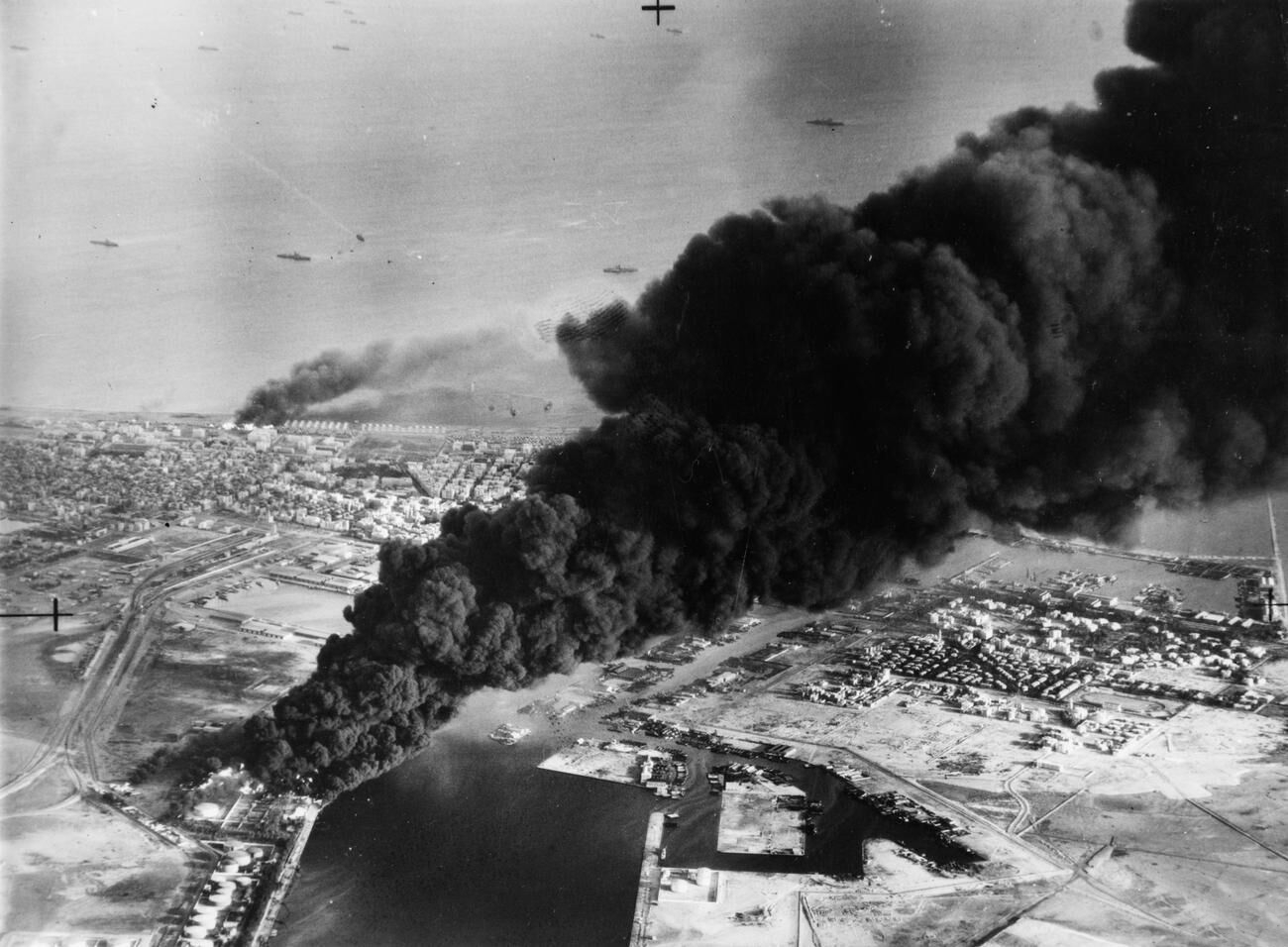
Israel attacked on 29 October 1956. The Anglo-French ultimatum followed on schedule. On 31 October, British and French aircraft began bombing Egyptian airfields. Paratroopers landed on 5 November, and amphibious forces followed on 6 November. Militarily, the operation was succeeding.
Politically and financially, it was already a catastrophe.
Eisenhower was furious. The American president had been kept in the dark about the Sevres agreement, and he regarded the Anglo-French action as a reckless throwback to nineteenth-century gunboat diplomacy at precisely the wrong moment. The Soviet Union had just invaded Hungary, and the spectacle of Western democracies invading a sovereign nation undercut Washington's moral authority to condemn Moscow. Eisenhower saw Eden's adventure as a gift to Soviet propaganda.
But Eisenhower's anger was not merely rhetorical. He had a weapon far more devastating than any military response: the American financial system. And he was prepared to use it.
The Financial Weapon
What followed was one of the most remarkable exercises of economic coercion in modern history. The United States attacked sterling on multiple fronts simultaneously (Kyle, 1991).
First, the US Treasury began selling sterling on the open foreign exchange markets. This was not passive disapproval — it was active financial warfare against an ally. By adding selling pressure to a currency already under speculative attack, the Treasury accelerated the pound's decline and magnified the drain on British reserves.
Second, Washington blocked Britain's access to its drawing rights at the International Monetary Fund. Britain had a legal entitlement to draw on IMF resources in a balance-of-payments crisis. The United States, as the IMF's largest shareholder, used its influence to ensure those funds would not be released until Britain agreed to a ceasefire and withdrawal. The message was unambiguous: there would be no international safety net for a country that defied American wishes.
Third, and perhaps most threatening of all, the Eisenhower administration signalled that it was prepared to dump American holdings of sterling bonds on the open market. The United States held substantial quantities of sterling-denominated securities. A forced sale would have cratered the bond market, driven up British borrowing costs, and potentially triggered a full-scale financial crisis in London.
The combination was devastating. Britain was haemorrhaging reserves at a rate that Macmillan later described as terrifying. In the first week of November alone, the Bank of England lost over $100 million defending the pound's fixed rate. At that pace, Britain's reserves would have been exhausted within weeks.
The Chancellor Changes His Mind
Macmillan's transformation from hawk to dove is one of the most instructive episodes in the history of financial statecraft. In the early months of the crisis, he had been among Eden's strongest supporters, dismissing American objections and insisting that Britain must act decisively. He told colleagues that Nasser had to be taught a lesson.
Then he saw the reserve figures for November.
On 6 November 1956, Macmillan went to Eden and delivered the news in stark terms. The reserves were collapsing. The Americans were blocking IMF support. Sterling was under assault from every direction. Without immediate access to dollar financing, Britain would be forced into a devaluation that would devastate the sterling area and destroy what remained of British financial credibility. The military operation might be succeeding in the Sinai, but the financial operation was failing in London. And in the modern world, the financial operation was the one that mattered (Johnman, 1989).
Eden capitulated. At midnight on 6 November — less than 48 hours after the amphibious landings — Britain announced a ceasefire. The French, who had no independent means of continuing without British support, followed suit. Israel, under separate American pressure, eventually withdrew from the Sinai as well.
The humiliation was total. British forces had been performing well in the field. The Canal was within their grasp. But none of it mattered because Britain could not afford to keep fighting. A great power had been brought to heel not by a superior military force but by a superior balance sheet.
The IMF Rescue — With Conditions
Once Britain announced its withdrawal, Washington's posture changed overnight. The financial weapon was sheathed, and the healing began — but on American terms.
The IMF approved a $1.3 billion standby arrangement for Britain in December 1956, the largest such facility to that date. The United States also arranged a $500 million line of credit from the Export-Import Bank. The money flowed, the reserves stabilised, and sterling survived at its $2.80 peg — for the time being.
But the price was not merely financial. It was strategic. Britain had been forced to demonstrate, before the entire world, that it could not act independently of American wishes. The so-called special relationship, which British politicians liked to describe as a partnership of equals, had been revealed as nothing of the sort. It was a relationship between a creditor and a debtor, and in such relationships, the creditor sets the terms.
The Canal Reopened — And the World Kept Turning
One of the deepest ironies of Suez is that the catastrophe Eden feared — Egyptian control of the Canal — turned out to be a non-event. After the crisis, the Suez Canal was cleared of the ships Nasser had ordered scuttled as a blockade measure and reopened under Egyptian management in April 1957. The pilots whom British officials had insisted only Europeans could provide were replaced by Egyptian and other international pilots. Oil continued to flow. Ships continued to transit. The Canal operated more efficiently under Nasser than many Western commentators had predicted (Yergin, 1991).
Eden's premise — that the Canal could not function without British and French control — was simply wrong. And the military operation designed to prove that premise had instead demonstrated something far more consequential: that Britain was a power whose reach had permanently exceeded its financial grasp.
The Long Retreat
Suez set in motion a chain of consequences that unravelled the British Empire within fifteen years. The most direct was the acceleration of decolonisation. In 1957, Harold Macmillan — now Prime Minister, having replaced the broken Eden — delivered his famous "wind of change" speech in Cape Town, acknowledging that African nationalism was an unstoppable force. Between 1957 and 1968, Britain granted independence to Ghana, Nigeria, Kenya, Uganda, Tanzania, Malaysia, Singapore, and dozens of other territories. The pace would have been unthinkable before Suez.
Strategically, the lesson was absorbed in stages. The 1957 Defence White Paper, produced under Defence Secretary Duncan Sandys, began the process of reducing Britain's conventional military footprint. In 1968, the Wilson government announced the withdrawal from "East of Suez" — the abandonment of military bases and commitments in Aden, the Persian Gulf, Singapore, and Malaysia. By 1971, Britain had retreated from virtually every position east of the Mediterranean.
The sterling area itself entered terminal decline. Countries that had kept their reserves in London began diversifying into dollars, a process accelerated by the persistent weakness of sterling through the 1960s. When Harold Wilson was finally forced to devalue the pound from $2.80 to $2.40 in November 1967 — the devaluation Macmillan had narrowly avoided in 1956 — the sterling area's remaining coherence dissolved. Wilson's famous reassurance that the devaluation did not affect "the pound in your pocket" was technically true for domestic transactions but meaningless for the governments and central banks that held sterling as a reserve asset.
Dollar Hegemony Confirmed
If Suez demonstrated the limits of British financial power, it equally confirmed the supremacy of American financial power. The crisis showed that the United States could bring a major ally to its knees without deploying a single soldier — simply by manipulating currency markets, controlling access to international financial institutions, and threatening to use its position as a creditor.
This was a new kind of power, and Washington would use it repeatedly in the decades that followed. The Nixon Shock of 1971, when the United States unilaterally suspended dollar-gold convertibility, was in some respects an extension of the same logic: the country that controls the reserve currency controls the rules. When the Yom Kippur War of 1973 produced another Suez-adjacent crisis, it was American financial and diplomatic muscle — not European — that shaped the outcome.
The Bretton Woods system that had been designed to create multilateral monetary governance had instead produced a hierarchy. At the top sat the United States, whose currency was the system's anchor and whose Treasury could make or break any country that depended on dollar liquidity. Britain had learned this lesson at Suez. Others would learn it later, in different circumstances, but the underlying dynamic remained the same.
The Lesson That Echoes
Suez is remembered in Britain as a national humiliation, the moment the country's self-image as a global power collided with the reality of its financial dependence. But it is worth recalling with precision what actually happened. Britain did not lose a military engagement. It did not suffer a diplomatic setback that might have been managed or finessed. It was forced to surrender a military victory because it could not pay for it. The empire ended not with a military defeat but with a balance-of-payments crisis.
Harold Macmillan understood this better than anyone. He had been the hawk who became a dove, the Chancellor who watched the reserves drain and understood what the numbers meant before anyone else in the cabinet. When he became Prime Minister in January 1957, he carried with him the central insight of Suez: that military power without financial independence is theatre. Britain could still field competent armed forces, still manufacture advanced weapons, still project power across the globe. But none of it counted for anything if a single phone call from Washington could collapse the currency.
Every nation that has since contemplated military action while running a current account deficit, while depending on foreign creditors for the stability of its currency, while relying on international institutions controlled by a rival — every such nation is replaying some version of the Suez calculation. The specific actors change. The financial arithmetic does not.
Eden resigned in January 1957, officially on grounds of ill health. He never held public office again. Nasser kept the Canal. Sterling limped on for another decade before its inevitable devaluation. And the lesson of November 1956 — that the balance sheet is the final battlefield — has never been refuted.
Related
Historical records Learn more about our methodology.