Mexico's Economic Miracle
Few economic turnarounds in the twentieth century were as dramatic — or as celebrated — as Mexico's transformation between 1988 and 1994. President Carlos Salinas de Gortari inherited an economy scarred by the debt crisis of the 1980s, a decade of stagnation economists had taken to calling "the lost decade." What he built, with the help of a generation of Harvard- and Chicago-trained technocrats known as the tecnócratas, looked like proof that market liberalization could work anywhere.
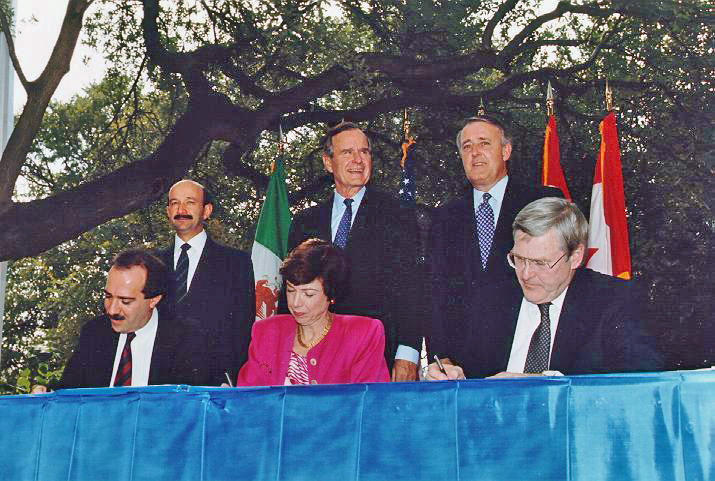
Inflation, which had peaked at 160% in 1987, was wrestled down to single digits by 1993. State enterprises were privatized at remarkable speed — banks, telephone companies, airlines, steel mills. Foreign investment poured in, drawn by low labor costs, proximity to the United States, and a government that spoke fluently the language of Wall Street. The centerpiece of the whole project was NAFTA, the North American Free Trade Agreement, which came into force on January 1, 1994, binding Mexico's economy to those of the United States and Canada in the largest free trade zone on Earth.
International capital markets rewarded the project lavishly. Net private capital inflows to Mexico rose from $3.2 billion in 1989 to $30.8 billion in 1993 (Sachs, Tornell, and Velasco, 1996). Mexico was admitted to the OECD in 1994, a signal recognition that it had joined the club of advanced economies. Morgan Stanley and Goldman Sachs analysts competed to publish the most effusive praise of what they were calling the "Mexican miracle."
Beneath the surface, however, structural tensions were building. Mexico's exchange rate was pegged to the dollar within a narrow crawling band — a policy that had succeeded in anchoring inflation expectations but that, by 1993, had produced a real exchange rate appreciated by perhaps 25% relative to its 1987 level. Mexican exports were becoming expensive by international standards. Imports were becoming cheap. The current account deficit — the gap between what a country spends and what it earns abroad — widened alarmingly, reaching 6.5% of GDP in 1993 and climbing toward 8% by 1994.
That deficit was being financed, in large part, by short-term capital inflows. And increasingly those inflows were denominated in dollars. The Mexican government had been rolling over its peso-denominated treasury bills, tesobonos convertibles, into dollar-linked instruments also called tesobonos. By December 1994, outstanding tesobono debt stood at roughly $29 billion — essentially the entire stock of Mexico's foreign exchange reserves. The country had, in effect, borrowed in a foreign currency while appearing to borrow at home. Economists would later give this practice a name: original sin.
The Year That Broke the Model
Even had Mexico's fundamentals been pristine, 1994 would have been a difficult year. It was, in fact, the most politically violent in living memory.
On January 1 — the very day NAFTA took effect — a guerrilla army calling itself the Ejército Zapatista de Liberación Nacional seized several towns in the southern state of Chiapas. The Zapatistas, led by the masked Subcomandante Marcos, declared war on NAFTA as a death sentence for indigenous Mexicans. The uprising was suppressed militarily within days, but it shattered the image of Mexico as a pacified, modernizing nation. International investors, already alert to currency risk, updated their threat models.
March brought something worse. Luis Donaldo Colosio, the ruling PRI's presidential candidate and the man almost universally expected to become Mexico's next president, was shot in the head at a campaign rally in Tijuana on March 23. He died hours later. Mexico had not experienced a political assassination of this magnitude since 1928. The peso fell sharply in the days that followed; the Bank of Mexico spent $11 billion in reserves defending the peg in a single month.
In September, José Francisco Ruiz Massieu, secretary-general of the ruling party, was assassinated on a Mexico City street. The year's accumulating violence was now indistinguishable, in market psychology, from systemic political risk.
Meanwhile, the Federal Reserve had been raising interest rates with persistent determination. Between February and November 1994, the Fed funds rate rose from 3% to 5.5% — a 250-basis-point increase in ten months (Calvo and Mendoza, 1996). Higher US rates meant higher returns on dollar-denominated assets at home. Capital that had found its way to higher-yielding Mexican instruments began, quietly at first, to flow back northward. The current account deficit was now being financed by ever-shorter-term inflows from investors who could exit at a moment's notice.
By November 1994, Mexico's foreign exchange reserves had fallen from $28 billion at the start of the year to barely $12 billion. The new government of Ernesto Zedillo, inaugurated on December 1, inherited a deteriorating situation and a commitment to a fixed exchange rate that was rapidly becoming indefensible.
The Botched Devaluation
What followed was a masterclass in how not to manage a currency crisis.
On December 19, 1994, Zedillo's economic team — led by Finance Minister Jaime Serra Puche — convened a meeting with prominent businesspeople and politicians to inform them of an impending devaluation. This was a well-intentioned attempt at consultation. It was also a catastrophic leak. Those present had hours to move capital before the general public knew anything. When Serra Puche announced a 15% widening of the peso's trading band the following morning, the market responded with fury rather than relief.
The announcement was poorly structured. A 15% band widening was ambiguous — was it a controlled adjustment or a first step toward free float? Confidence, already fragile after a year of political shocks and reserve depletion, evaporated entirely. Investors who had been nervous but patient began selling pesos with abandon. The Bank of Mexico burned through $4 billion in reserves in a single day.
Within 48 hours, Serra Puche abandoned the band entirely and let the peso float. It immediately collapsed. The rate, which had been held at approximately 3.47 pesos per dollar, fell to 4.65 by December 22 and accelerated through 5, 6, and 7 pesos over the following weeks.
Serra Puche resigned after just 29 days in office. His replacement, Guillermo Ortiz, would spend the next two years attempting to restore credibility while managing an economy in freefall. The peso ultimately lost more than 50% of its pre-crisis value against the dollar before stabilizing. Mexican GDP contracted by 6.2% in 1995, the sharpest single-year decline since the Great Depression. Unemployment doubled. Thousands of businesses defaulted on their loans. Mortgage rates, tied to inflation, made homeownership unaffordable for a generation of middle-class Mexicans who had bought homes during the boom years.
The Tequila Effect
Markets do not respect national borders, and they rarely wait for fundamental analysis before making their judgments. Within days of Mexico's devaluation, traders around the world began selling the currencies and bonds of any country that resembled Mexico even superficially — high current account deficits, dollar-denominated short-term debt, a peg that might not hold. The result was a wave of financial contagion that economists christened, with characteristic dark humor, the "Tequila Effect."
Argentina bore the brunt of it. Buenos Aires had pegged the peso to the dollar at one-to-one under the Convertibility Plan of 1991 — a commitment backed by law and near-religious belief in its necessity after the inflation catastrophes of the 1980s. When Mexico's peso collapsed, investors looked at Argentina and saw familiar vulnerabilities: a large current account deficit, dollar-linked banking system, and an economy dependent on foreign capital. Bank deposits fell by $8 billion in three months — roughly 18% of the total. The banking system tottered. Argentina survived, barely, by jacking up interest rates dramatically and receiving emergency financing from the IMF and World Bank. But the damage was severe: GDP contracted by 4.4% in 1995.
| Country | Capital Outflow Peak | GDP Impact (1995) | Currency Pressure |
|---|---|---|---|
| Mexico | Reserves fell from $28bn to $6bn | −6.2% | Peso lost ~53% |
| Argentina | Deposits fell 18% ($8bn) | −4.4% | Peg survived, barely |
| Brazil | $9bn capital flight in weeks | +4.2% (held) | Real devalued 6% |
| Peru | Significant reserve loss | +7.1% (held) | Sol depreciated 4% |
| Philippines | Bond spreads spiked | +4.7% (held) | Peso lost 4% |
Brazil, for all its perceived similarities to Mexico, managed to contain the damage. The Real Plan of 1994 — which had ended Brazil's chronic hyperinflation — was only months old and had built significant goodwill. President Cardoso, the plan's architect, raised interest rates sharply and signaled unwavering commitment to the new currency. Brazil took a hit but did not break. Peru and the Philippines experienced similar episodes of market anxiety. The contagion was real but uneven — a reminder that investors punish the weakest links first but do not always have the patience to distinguish carefully among those they lump together.
The Rescue: Wall Street, Washington, and the ESF
The Clinton administration watched Mexico's deterioration with mounting alarm. The geopolitical stakes were obvious. Mexico was America's southern neighbor, its second-largest trading partner, and the freshly minted NAFTA partner. A complete economic collapse would send waves of migrants northward and destabilize the one Latin American country that Washington had championed as proof that market democracy worked. It would also bankrupt many of the American mutual funds, pension funds, and investment banks that had bought Mexican tesobonos in large quantities.
Robert Rubin, who had just been confirmed as Treasury Secretary, and his deputy Larry Summers took charge of assembling a rescue. Their first attempt — a $40 billion loan guarantee program — required Congressional approval. Congress balked. Republican leaders, fresh from their November 1994 landslide, were not inclined to bail out Wall Street investors who had made bad bets in Mexico. Public opposition was fierce.
Rubin reached into the Treasury's toolbox and found the Exchange Stabilization Fund: a Depression-era reserve established by the Gold Reserve Act of 1934, originally intended to stabilize the dollar. It had never been used at anything like the scale now contemplated, and its use required no Congressional authorization. Clinton approved it. The US committed $20 billion from the ESF; the IMF contributed $17.8 billion in a standby arrangement — the largest ever at the time; the Bank for International Settlements added $10 billion; Canada contributed $3 billion. Total package: approximately $50 billion.
The political backlash was considerable. Critics argued — with some justice — that the rescue primarily protected foreign investors who had made speculative bets, and that it created a moral hazard that would encourage future risk-taking in emerging markets. Jeffrey Sachs, then at Harvard, condemned what he called the "Wall Street Treasury complex" — his term for the revolving door between investment banking and economic policymaking that had produced a bailout calibrated to protect bondholders rather than ordinary Mexicans (Sachs, Tornell, and Velasco, 1996). Rubin himself was a former Goldman Sachs co-chairman. Summers's close relationships on Wall Street were equally well documented.
Whatever its political complexion, the rescue worked. The peso stabilized around 6 to 7 pesos per dollar. Mexican interest rates, which had spiked to over 80% annually, began falling as confidence returned. The government implemented austerity measures — spending cuts, tax increases, emergency privatizations — that were wrenching but effective. And critically, Mexico began repaying the US loans ahead of schedule. By January 1997, the entire ESF loan was repaid, with interest, three years early. Rubin called it one of the best investments the US government had ever made.
Lessons Written in Devalued Currency
The Mexican crisis produced a literature of post-mortems, and several of its lessons proved durable enough to be cited again, almost word-for-word, during the Asian financial crisis of 1997–1998 just three years later.
The most fundamental was the danger of what economists call "original sin" — the practice of borrowing in foreign currency. Mexico's tesobonos looked, on the surface, like domestic debt. They were issued by the Mexican government, traded in Mexico City, and held by Mexican institutions. But they were dollar-indexed, which meant that when the peso fell, their cost in local-currency terms exploded. A country that borrows in its own currency can always inflate its way out of trouble, at the cost of domestic creditors. A country that borrows in dollars cannot. When Mexico devalued, its dollar-denominated liabilities effectively doubled in peso terms overnight.
The second lesson concerned fixed exchange rates in a world of mobile capital. The Bretton Woods system of fixed rates had functioned from 1944 to 1971 precisely because capital controls limited international capital flows — as the Bretton Woods architecture was designed to do. In the liberalized financial world of the 1990s, those controls were gone. Foreign exchange reserves that might have lasted weeks in 1965 could be exhausted in hours by a coordinated run. Pegs that were economically appropriate when set could become misaligned within months as inflation differentials, commodity price shifts, or capital flows reshaped relative competitiveness. Defending them required either enormous reserves, massive interest rate increases, or ultimately capitulation.
Third was the speed of contagion. In an era of real-time capital flows and global portfolio management, a crisis in Mexico could become a crisis in Buenos Aires before Argentine Finance Ministry officials had finished reading the morning newspapers. Investors who categorized Mexico and Argentina as interchangeable "Latin American emerging markets" did not necessarily distinguish carefully between them. When one broke, the category was suspect.
The crisis also influenced how the IMF approached subsequent emergencies. The $17.8 billion standby arrangement was unprecedented in scale, and the Fund's willingness to act quickly and at massive scale set a precedent for the even larger packages assembled during the Asian crisis of 1997. But Mexico also exposed a gap in the IMF's toolkit: it had mechanisms for lending to countries in balance of payments trouble, but no good instrument for providing rapid liquidity to countries experiencing confidence crises driven by short-term capital flows rather than fundamental insolvency. Efforts to develop such instruments — the Contingent Credit Line, later the Flexible Credit Line — were direct responses to the Mexican experience (Obstfeld, Shambaugh, and Taylor, 2010).
The Argentine collapse of 2001–2002 confirmed how incompletely those lessons had been absorbed. Argentina held on to its dollar peg through the Tequila Effect, through the Brazilian devaluation of 1999, and into a deepening recession — accumulating precisely the vulnerabilities that had destroyed Mexico in 1994. When it finally broke, in December 2001, the anatomy of the collapse was almost identical: a fixed peg that had become overvalued, a current account deficit financed by external borrowing, a government debt structure that had been shifted into dollar-denominated instruments, and a loss of market confidence that triggered a self-fulfilling run.
The Morning After
Mexico recovered from the crisis faster than almost anyone had expected. By 1996, GDP was growing again at over 5%. The peso found a new, weaker equilibrium. Exports surged as the cheaper currency made Mexican goods competitive once more; the devaluation that had been so catastrophically mismanaged was, in retrospect, economically necessary. NAFTA trade flows expanded steadily through the late 1990s, and Mexico's export sector became one of the most dynamic in the developing world.
The human cost, however, was not recovered so quickly. Real wages in Mexico took the better part of a decade to return to their pre-crisis levels. Poverty rates, which had been declining through the early 1990s, spiked sharply and remained elevated. A generation of middle-class Mexicans who had borrowed at variable interest rates to buy homes and cars found themselves trapped in debts that multiplied as the crisis unfolded.
The tesobono crisis was, in miniature, a preview of the financial architecture problems that would plague emerging markets for the next decade. It demonstrated that the combination of a fixed exchange rate, a current account deficit, and short-term foreign-currency debt created a fragile triangle that could collapse abruptly under the weight of investor doubt. It showed that capital flows could reverse with a speed that no central bank's reserves could easily absorb. And it revealed that when a government tries to manage a devaluation gradually and confidentially, it often ends up accelerating the panic it was trying to prevent.
Jaime Serra Puche arrived at the Finance Ministry on December 1, 1994, planning to oversee a gentle depreciation that would restore competitiveness without drama. He left on December 29 having presided over one of the most chaotic currency collapses in Latin American history. The distance between those two outcomes was nineteen days, an ill-timed announcement, and the accumulated weight of every vulnerability that had been building, quietly, for years — proof that in finance, the gap between managed decline and uncontrolled crisis is thinner than any government ever believes until it has crossed it.
Related
Historical records Learn more about our methodology.