After Waterloo, a Flood of Easy Money
On June 18, 1815, Napoleon Bonaparte met his final defeat at Waterloo. Within months, Britain began demobilizing an army that had consumed roughly a quarter of government revenue for over two decades. War bonds matured, military contracts evaporated, and a generation of investors suddenly found themselves awash in capital with nowhere familiar to deploy it. Interest rates on British government consols — the benchmark safe asset of the era — fell below 4 percent, and by 1824 they dipped toward 3 percent. For yield-hungry investors, this was intolerable. They went looking for excitement, and Latin America obliged.
Across the Atlantic, Spain's colonial empire was disintegrating. Newly independent republics in Colombia, Peru, Chile, Mexico, and Buenos Aires needed capital to build governments, armies, and infrastructure. London bankers — Baring Brothers, B.A. Goldschmidt, and dozens of smaller houses — were only too happy to underwrite sovereign bonds for these fledgling nations, earning fat commissions in the process. Between 1822 and 1825, Latin American governments raised approximately 20 million pounds on the London market (Neal, "The Financial Crisis of 1825 and the Restructuring of the British Financial System," Federal Reserve Bank of St. Louis Review, 1998). Mining companies promised even greater riches. Prospectuses described silver veins of unimaginable wealth in Mexico and Peru, gold deposits waiting to be scooped from riverbeds. Most investors had never set foot in South America and had no way to verify any of it.
Gregor MacGregor and the Country That Never Was
No episode captures the madness of the 1820s bubble more vividly than the Poyais fraud. Gregor MacGregor, a Scottish soldier of fortune who had fought in Venezuela's independence wars, returned to London in 1822 styling himself the Cazique — prince — of Poyais, a territory he claimed to govern on the Mosquito Coast of present-day Honduras. MacGregor was charming, well-connected, and utterly shameless. He produced a detailed guidebook describing Poyais as a fertile land with a capital city, a cathedral, an opera house, and a bank. He issued Poyais currency, appointed ambassadors, and sold 200,000 pounds worth of government bonds at 6 percent interest on the London exchange.
Investors bought eagerly. Some 250 settlers — tradespeople, farmers, servants — booked passage to their new homeland. When they arrived in early 1823, they found nothing but swamps and jungle. No capital, no cathedral, no settlement of any kind. Dozens died of tropical disease before the survivors were rescued by a passing ship and taken to Belize. MacGregor, astonishingly, was never convicted. He fled to France, attempted the same scheme in Paris, and eventually retired to Venezuela on a military pension (Sinclair, The Pound: A Biography, 2000).
Poyais was the most brazen fraud, but it existed on a spectrum. Many of the mining companies floated during the boom were barely less fictional — shells organized around vague concessions, promoted by men who knew nothing about mining, and bought by investors who knew even less about geography.
Source: Bank of England Historical Statistics, reconstructed from parliamentary records
Fueling the Fire From Threadneedle Street
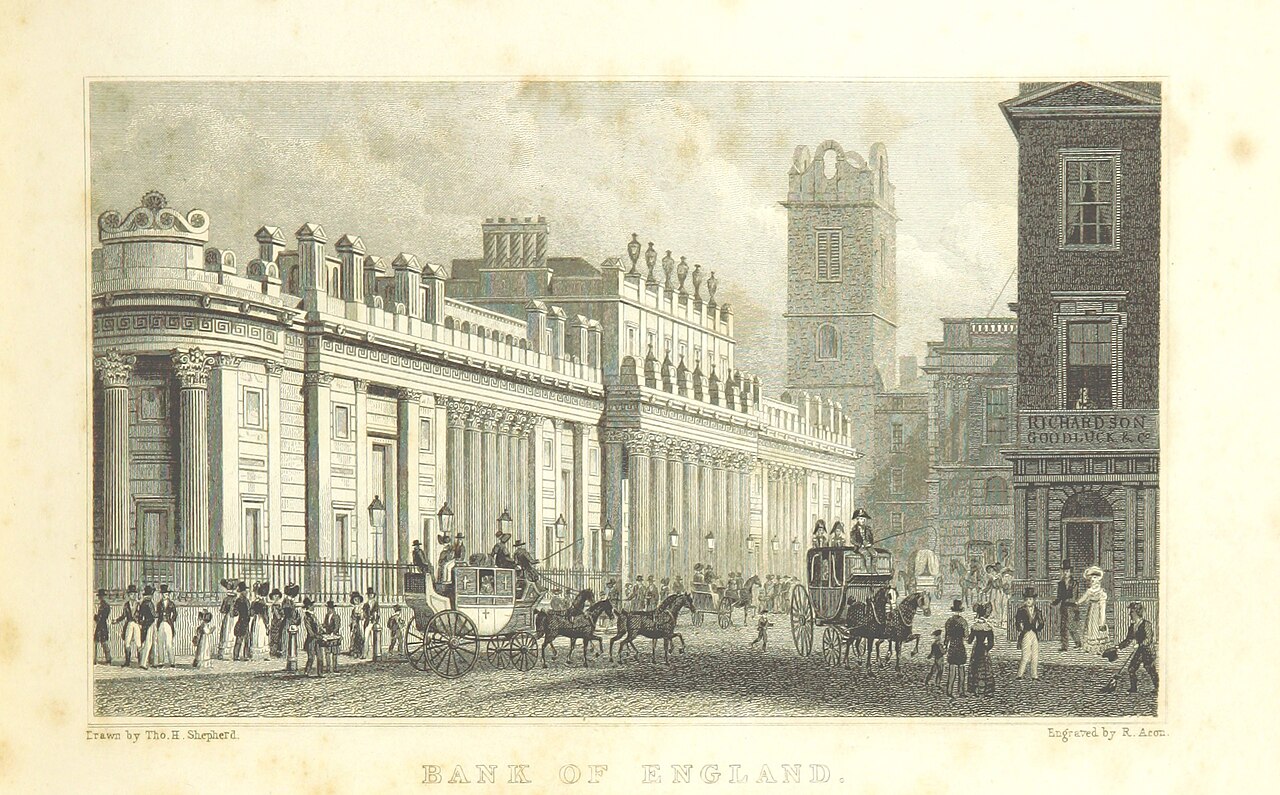
At the center of it all sat the Bank of England. Although nominally a private corporation, the Bank functioned as the government's banker and held a de facto monopoly on note issue in London. Its directors had a choice: restrain credit and cool the speculation, or accommodate the boom and enjoy the profits. They chose the latter. Between 1823 and 1825, the Bank expanded its note circulation and discounted bills liberally, feeding cheap money into a financial system already drunk on Latin American dreams.
Country banks — the hundreds of small, privately owned banks scattered across England and Wales — amplified the effect. Under existing law, no bank other than the Bank of England could have more than six partners, which meant country banks were chronically undercapitalized. They issued their own banknotes, often backed by little more than optimism. When the Bank of England kept money loose, country banks lent aggressively, creating a credit pyramid that stretched from Threadneedle Street to the smallest market town.
By mid-1825, the signs of excess were unmistakable. Share prices for mining companies had doubled and tripled from their issue prices. New company promotions appeared daily. Parliament chartered 624 joint-stock companies in 1824-1825 alone, capitalizing them at a combined 370 million pounds — a staggering sum in an economy whose entire GDP was roughly 400 million pounds (Bordo, "Commentary on the Financial Crisis of 1825," Federal Reserve Bank of St. Louis Review, 1998). Informed observers grew uneasy. Nathan Rothschild, the shrewdest financier in London, quietly began accumulating gold.
December 1825: The System Breaks
Confidence began cracking in the autumn. Several Latin American bonds defaulted as the new republics proved unable to service their debts. Mining company shares started falling as reports filtered back from South America — reports of flooded tunnels, nonexistent ore deposits, and equipment rusting on distant docks. On December 5, 1825, the prominent London banking house of Pole, Thornton & Co. suspended payments, triggering a full-scale panic.
What followed was weeks of chaos. Depositors queued outside banks across London and the provinces. Country banks, their reserves thin and their note-holders demanding gold, collapsed in rapid succession. Within six weeks, at least 73 banks failed — some estimates place the figure closer to 93 (Clapham, The Bank of England: A History, 1944). The stock market cratered. Mining shares that had traded at premiums of 200 percent fell to zero.
| Metric | Pre-Crisis Peak (mid-1825) | Crisis Trough (Dec 1825 - Jan 1826) |
|---|---|---|
| Bank of England gold reserves | ~11 million pounds | ~1 million pounds |
| Country banks in operation | ~770 | ~690 (73+ failed) |
| Latin American bond prices | 75-90% of par | 15-30% of par |
| Mining share prices | 200-500% of issue | Near zero |
| Bank rate | 4% | 5% (raised during crisis) |
One Million Pounds From Catastrophe
Inside the Bank of England, panic was barely contained. Gold reserves, which had stood at over 11 million pounds in early 1823, plunged as depositors and note-holders converted paper into metal. By mid-December, the Bank's gold had fallen to roughly 1 million pounds — possibly as low as 100,000 pounds on a single day, according to some accounts, though the exact figure remains disputed (Kynaston, Till Time's Last Sand: A History of the Bank of England, 2017). Jeremiah Harman, a Bank director, later testified to Parliament that the institution had been within hours of having to suspend cash payments entirely — an event that would have destroyed confidence in the pound and potentially collapsed the entire British monetary system.
In desperation, the Bank resorted to every expedient it could find. It accepted collateral it would normally have refused, discounted bills it would ordinarily have rejected, and — in a move that directly prefigured modern central banking — began lending to any solvent institution that could present adequate security. Most critically, an emergency shipment of gold sovereigns arrived from Nathan Rothschild's Paris branch, part of the family's vast continental reserves. Rothschild had anticipated the crisis and positioned himself to profit from it, but his gold also kept the Bank of England — and the British financial system — alive.
Bagehot's Dictum: A Doctrine Born From Disaster
Nearly five decades later, Walter Bagehot drew directly on the lessons of 1825 when he wrote Lombard Street (1873), the most influential treatise on central banking ever published. Bagehot's prescription was deceptively simple: in a crisis, the central bank must lend freely, at a penalty rate, against good collateral. Refuse to lend and the panic spreads. Lend at normal rates and you subsidize recklessness. Lend against bad collateral and you invite fraud. But lend generously to solvent institutions at rates high enough to discourage borrowing except in genuine emergency, and you can arrest the panic without rewarding the speculators who caused it.
Bagehot did not invent this principle in the abstract. He extracted it from what the Bank of England had been forced to learn the hard way in December 1825 — and from what it had failed to do quickly enough. Had the Bank tightened credit earlier, the bubble might have deflated gradually. Had it lent freely sooner during the crash, fewer banks might have failed. Every central banker who has managed a financial crisis since — from the Panic of 1907 to the 2008 global financial crisis — has operated, whether consciously or not, within the framework Bagehot codified from the wreckage of 1825.
Reform: Joint-Stock Banking and the End of the Old System
Parliament acted swiftly in the aftermath. An 1826 act permitted the formation of joint-stock banks with more than six partners — but only outside a 65-mile radius of London — breaking the Bank of England's effective monopoly and allowing the creation of larger, better-capitalized institutions in the provinces. A further act in 1833 extended joint-stock banking to London itself.
Country banks were also prohibited from issuing notes for less than five pounds, a measure intended to reduce the volume of small-denomination paper currency that had circulated so recklessly during the boom. Gradually, the Bank of England's notes replaced those of the country banks, centralizing monetary authority in ways that would culminate in the Bank Charter Act of 1844, which gave the Bank of England a formal monopoly on note issue in England.
| Reform | Year | Significance |
|---|---|---|
| Joint-stock banking outside London | 1826 | Allowed banks with unlimited partners, improving capitalization |
| Small note prohibition | 1826 | Banned country bank notes under five pounds |
| Joint-stock banking in London | 1833 | Extended reform to the capital |
| Bank Charter Act | 1844 | Gave Bank of England monopoly on new note issue |
These reforms did not prevent future crises — the panics of 1847, 1857, and 1866 would each test the system anew. But they marked the beginning of a structural transformation in British banking, from a fragmented patchwork of tiny, undercapitalized private banks to a system anchored by larger joint-stock institutions and backstopped, however imperfectly, by a central bank that was slowly learning its role.
A Template That Endures
What makes the Panic of 1825 historically significant is not its scale — later crises would be larger — but its legacy as the moment when the modern concept of central bank crisis management was born. Before 1825, the Bank of England behaved primarily as a commercial bank that happened to manage the government's accounts. After 1825, it began — haltingly, reluctantly, and with many missteps — to accept responsibility for the stability of the entire financial system.
Every element of a modern financial crisis was present in 1825: cheap credit fueling asset speculation, financial innovation outpacing regulation, fraud flourishing in the gap between investor enthusiasm and due diligence, contagion spreading from one institution to the next, and a central authority forced to choose between letting the system collapse and intervening in ways that rewarded the reckless. Latin American bonds in the 1820s, railroad stocks in the 1870s, subprime mortgages in 2008 — the assets change, but the architecture of crisis does not.
Bagehot understood this permanence. Writing in 1873, he observed that periodic panics were an inherent feature of a credit-based economy, not aberrations that proper management could eliminate. What mattered was not preventing manias — that was probably impossible — but ensuring that the central bank stood ready to contain the damage when they inevitably collapsed. That insight, forged in the near-death experience of December 1825, remains the single most important principle in central banking today.
Related
Historical records Learn more about our methodology.