A Twelve-Minute Speech at Harvard
The afternoon of Thursday 5 June 1947 was warm and clear in Cambridge, Massachusetts. At about half past two, in the courtyard between the Memorial Church and Widener Library, Secretary of State George C. Marshall stepped up to the wooden lectern at Harvard's 296th commencement to accept an honorary doctor of laws. He read for roughly twelve minutes from a typed text that fewer than a dozen people had seen in advance. He used no notes beyond the page in his hand, and the audience — fifteen thousand graduates, families and faculty packed onto folding chairs in Tercentenary Theatre — applauded politely when he sat down, unaware that the United States had just committed itself to the largest peacetime economic intervention in another continent that any government had ever undertaken.
"It is logical that the United States should do whatever it is able to do to assist in the return of normal economic health in the world," Marshall told the gathering, "without which there can be no political stability and no assured peace." The operative paragraph followed a few sentences later. "The initiative, I think, must come from Europe. The role of this country should consist of friendly aid in the drafting of a European program and of later support of such a program so far as it may be practical for us to do so. The program should be a joint one, agreed to by a number, if not all European nations."
There was no figure attached to the offer. There was no list of countries. There was no draft legislation. What Marshall had done was convert a Department of State internal paper — drafted by George Kennan's Policy Planning Staff and refined over a fortnight in late May by Under Secretary Will Clayton — into a public commitment by reading it from a Harvard lectern. The European Recovery Program, as it would be called in the statute, ran for four years and three months. It moved $13.3 billion across the Atlantic, rebuilt the industrial base of sixteen countries, and assembled the institutional scaffolding on which the European Union now stands.
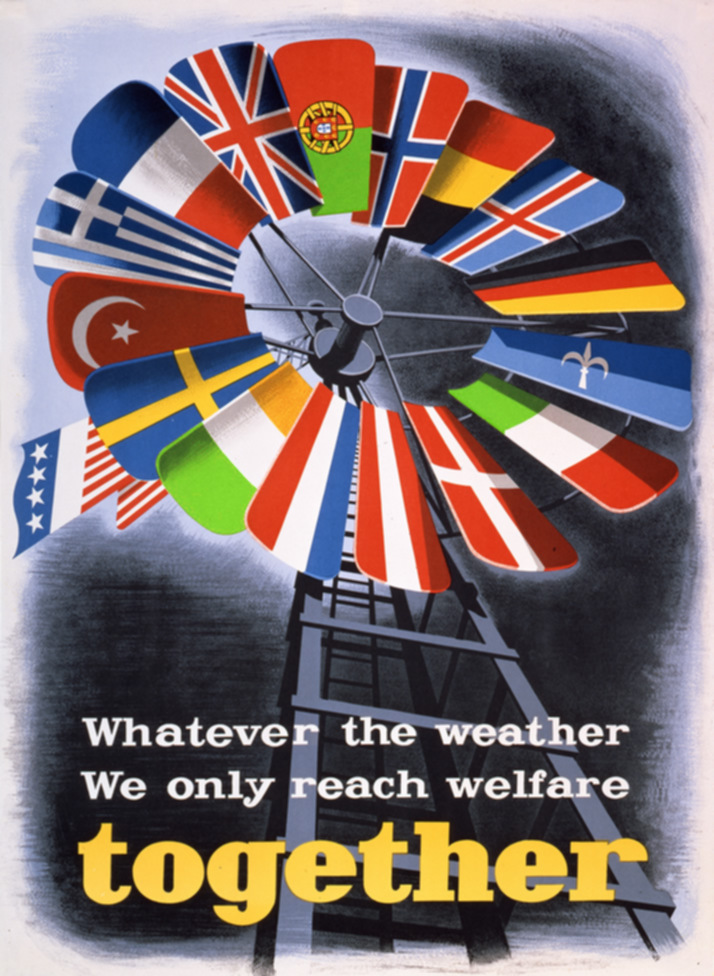
The Continent in Spring 1947
To register why Marshall's offer was met with the speed it was met, you have to look at the European balance sheet that spring. Industrial production in 1946 stood at roughly 83 percent of the 1938 level across Western Europe as a whole, but the headline number flattered the situation. Germany was at 34 percent. Italy was at 60. The Netherlands was at 74. Coal output in the Ruhr in early 1947 was running at half its prewar rate, and a winter so severe that the Thames had frozen at Windsor in February had drained the United Kingdom's dollar reserves at a pace that drew an alarmed memorandum from the Bank of England (Milward, 1984). Agricultural output across the continent was 15 percent below 1938. Cereal harvests for 1946 had been the worst recorded since the 1880s.
Behind the human crisis sat a structural problem — the dollar gap. Europe needed American grain, American coal, American capital goods and American cotton. It paid for those imports with exports it could no longer produce in sufficient volume, because the factories that had once produced them lay flattened in the Ruhr, in Hamburg, in Lyon, in Milan, in Rotterdam. The aggregate current-account deficit of the Western European economies with the dollar area in 1947 was running at about $7.5 billion annualised — close to the entire wartime Lend-Lease balance. The hard-currency reserves left over from the war were running out at a pace that pointed, on the Treasury's own arithmetic, to total exhaustion by mid-1948.
That same dollar shortage had been the operating constraint of the international monetary system since the IMF and World Bank opened for business — a story told in more detail in our piece on the Bretton Woods architecture of the postwar monetary order. The Bretton Woods institutions had been designed for an orderly transition to currency convertibility within five years of the war's end. By the time of Marshall's Harvard address it was clear that the timetable had collapsed. The pound was unconvertible. The franc traded at three different rates on three different markets. The Reichsmark had been replaced by cigarettes in much of urban Germany.
Soviet expansion was the other half of the picture. By the time Marshall reached the lectern, the Red Army occupied Poland, eastern Germany, Czechoslovakia, Hungary, Romania, Bulgaria and the Soviet zone of Austria. Communist parties polled 28.6 percent in France in November 1946 and 19 percent in Italy in June of the same year. The British Foreign Office had told Washington in February 1947 that London could no longer fund the Greek civil war on the royalist side. The Truman Doctrine, articulated in a speech to Congress on 12 March 1947, had committed $400 million to Greece and Turkey but had pointedly not addressed the underlying continental problem. Marshall's offer was — in a phrasing that George Kennan would later use in his memoirs — the economic half of a strategy whose military half was the Truman Doctrine.
Paris, Molotov, and the Sixteen
Within two weeks of Harvard, the British and French foreign ministers Ernest Bevin and Georges Bidault had agreed in London on a joint response. They invited the Soviet Union to a tripartite preparatory conference in Paris on 27 June. Vyacheslav Molotov arrived with a delegation of eighty-nine — economists, statisticians, security men — and stayed for six days. On 2 July, after an exchange of memoranda in which Bidault and Bevin insisted that aid had to be coordinated jointly and that recipient countries had to share information on their resources and balance-of-payments needs, Molotov declared the conditions an affront to sovereignty and left.
Molotov's departure was decisive. Within a week of his return to Moscow, the Polish and Czechoslovak governments — both of which had expressed interest in attending the follow-on conference — were instructed to refuse. Jan Masaryk, Czechoslovakia's non-communist foreign minister, reportedly remarked to colleagues in Prague on 10 July that he had "left for Moscow as the foreign minister of a sovereign state and returned as a Soviet lackey." Within seven months Masaryk would be dead, his fall from a Foreign Ministry window in February 1948 officially ruled a suicide and widely believed otherwise. The Cominform was founded in September 1947. The continent's east-west fracture was set.
A conference opened in Paris on 12 July 1947 that had sixteen participants — Austria, Belgium, Denmark, France, Greece, Iceland, Ireland, Italy, Luxembourg, the Netherlands, Norway, Portugal, Sweden, Switzerland, Turkey and the United Kingdom — sitting in committees from July through September to draft what became the September 1947 Report of the Committee of European Economic Co-operation. They submitted a four-year request for $22.4 billion, which the State Department's review process under William Clayton trimmed to $17.0 billion and which the Economic Cooperation Act of 1948, signed by Truman on 3 April 1948, authorised at $5.3 billion for the first fifteen-month tranche.
The Economic Cooperation Administration
Congress had created, through the Economic Cooperation Act, an Economic Cooperation Administration (ECA) an independent agency outside the State Department and reporting directly to the President. Truman named Paul Hoffman, the president of the Studebaker Corporation, to run it. Hoffman took the oath of office on 9 April 1948, six days after the act was signed, and ran the agency for the next two and a half years before handing over to William Foster in late 1950. Averell Harriman became the special representative in Europe, based in the Hôtel de Talleyrand at 2 rue Saint-Florentin in Paris. In each recipient country an ECA mission worked alongside the local government and reported back to Washington — a model that would be copied in every American foreign-aid programme of the next four decades.
Marshall's Paris counterpart was the OEEC — the Organisation for European Economic Co-operation, founded on 16 April 1948 to coordinate the European side of the programme. Its first secretary-general was Robert Marjolin, a thirty-six-year-old French economist who would later become the European Commission's first vice-president for economic affairs. The OEEC ran the annual allocation exercise in which each member submitted its dollar requirements and its export-availabilities, and a senior officials' committee — chaired by Sir Edmund Hall-Patch of the British Foreign Office for most of the first three years — negotiated cuts and trade-offs. The OEEC reconstituted itself as the OECD in 1961 with the addition of the United States and Canada as full members.
Source: OEEC, Industrial Statistics 1900–1955; UN, Economic Survey of Europe (various years)
That chart is the cleanest summary of what the Marshall years did and did not do. Industrial output had collapsed to about half its 1938 level by 1945 — a figure that for Germany was lower still and for the Netherlands and Italy fell in between. Recovery from that trough through 1947 had carried the regional index back to roughly 83, but in early 1948 the rate of recovery was visibly stalling under the dollar constraint. From the start of ERP disbursements in April 1948 the line accelerates. By 1950 the index had cleared 1938 by eighteen points. By 1952 it stood at 131. Whether the inflection in 1948 was caused by Marshall money or merely coincided with reforms that would have occurred anyway is the central empirical question of the programme's economic history (Eichengreen, 2007).
Aid by Country
Allocation across the sixteen participants was negotiated annually in Paris and ratified in Washington. The cumulative figures — usually given net of returns on shipping liens, conditional aid and Section 115 deductions — distribute as follows.
| Country | Total ERP aid 1948–52 (US$ million) | Share of total (%) | Grant : loan ratio |
|---|---|---|---|
| United Kingdom | 3,297 | 24.8 | 87 : 13 |
| France | 2,296 | 17.3 | 89 : 11 |
| Italy | 1,204 | 9.1 | 76 : 24 |
| West Germany | 1,448 | 10.9 | 60 : 40 |
| Netherlands | 1,128 | 8.5 | 76 : 24 |
| Greece | 707 | 5.3 | 100 : 0 |
| Austria | 678 | 5.1 | 99 : 1 |
| Belgium and Luxembourg | 559 | 4.2 | 60 : 40 |
| Denmark | 273 | 2.1 | 73 : 27 |
| Norway | 255 | 1.9 | 86 : 14 |
| Turkey | 225 | 1.7 | 50 : 50 |
| Ireland | 147 | 1.1 | 0 : 100 |
| Sweden | 107 | 0.8 | 80 : 20 |
| Portugal | 51 | 0.4 | 26 : 74 |
| Iceland | 29 | 0.2 | 79 : 21 |
| Other and regional | 925 | 7.0 | various |
| Total | 13,328 | 100.0 | 82 : 18 |
That distribution is worth a moment. The United Kingdom and France together absorbed forty-two percent of total ERP aid. Germany received less in dollar terms than France or Britain, despite having taken vastly heavier physical damage — a function of the policy decision, in force until 1950, to keep German per-capita aid below the Allied average. Greece and Turkey received aid that was overwhelmingly in grant form, reflecting their position on the front line of what was now Cold War geography. Ireland — neutral in the war, with relatively limited reconstruction needs — took its entire allocation as loans.
The European Payments Union
Most enduring among the programme's institutional inventions was the European Payments Union, agreed in Paris on 19 September 1950 and operational from 1 July 1950 retroactively to that signing date. The EPU was a multilateral clearing mechanism for the OEEC currencies, with the Bank for International Settlements in Basel acting as agent. Each month every member's bilateral balances with every other member were netted into a single position against the union; surpluses earned partial settlement in dollars and partial credit, deficits paid partial dollar settlement and drew partial credit. The credit facility was capitalised initially at $350 million from the ERP, with member quotas providing the rest. By 1955, when most members had restored convertibility, the EPU had cleared roughly $46 billion of intra-European trade balances without using more than a fraction of that figure in gold or dollar settlements (Eichengreen, 2007).
That arithmetic mattered because before the EPU each European country had been running bilateral trade arrangements with every other — twenty-eight currency pairs in formal operation by 1949, several of them settling in commodities and barter. The result was an intra-European trade pattern that ran perhaps thirty percent below what a multilateral payment system would have allowed. The EPU removed the bilateral clearing constraint inside two years. Intra-OEEC trade as a share of total OEEC trade rose from 41 percent in 1948 to 53 percent in 1953.
The Italian Election of April 1948
One outcome is worth singling out because of the weight that contemporaries placed on it. The Italian general election of 18 April 1948 was the first under the new republican constitution and the first in which the Communist-Socialist Popular Democratic Front, led by Palmiro Togliatti, faced the Christian Democrats led by Alcide De Gasperi as the alternative government. Polling in February had put the Front ahead. The Truman administration responded with a combination of psychological-warfare campaigns directed by the CIA — operative Frank Wisner authorised some $10 million in covert support for the Christian Democrats — and an unmistakable public signal that a communist victory would end Italy's participation in the ERP. Hoffman gave press conferences making the linkage explicit. ECA ships were photographed unloading wheat at Naples and Genoa in the weeks before the vote. The Christian Democrats won 48.5 percent on 18 April; the Front took 31. The political historian Lawrence Wittner has argued that the Marshall Plan signalling was decisive in the swing of perhaps eight to ten points (Hogan, 1987).
Was the Plan Decisive?
A cliometric debate that opened in the 1980s and ran through the 1990s arrived at a more measured verdict than the popular memory of the programme. Alan Milward's revisionist 1984 study argued that European recovery would have happened broadly along the same trajectory without Marshall aid, because the necessary physical capital and entrepreneurial knowledge had survived the war intact and because the underlying productivity gap with the United States created its own catch-up gradient (Milward, 1984). The most direct counter came in De Long and Eichengreen's 1993 working paper for the NBER, which conceded that the cash transfer was small — perhaps two percent of recipient-country GNP in the peak years, never more than four — but argued that the conditionality attached to the aid was decisive. ERP recipients had to commit to balanced budgets, currency stabilisation, intra-European trade liberalisation and, in the German case, the integration of their industry with that of former adversaries. Those reforms unlocked productivity gains an order of magnitude larger than the aid itself. The phrase they coined for the programme — "perhaps the most successful structural adjustment programme in history" — has stuck (De Long and Eichengreen, 1993).
Compare that record with the postwar settlement that followed the previous European war. The reparations imposed at Versailles in 1919, treated in our piece on the Weimar hyperinflation and the destruction of the mark, tried to make the loser pay the winner. The Marshall Plan inverted the logic. The winner paid for the losers' recovery, and built the institutions in which the losers became permanent allies. Britain's relative decline in the years that followed — examined in our piece on the Suez crisis and the end of the British financial empire — was the inverse face of the same shift, in which the dollar replaced sterling as the operating currency of the Western system. The Bretton Woods order that the programme buttressed would itself last until the gold window closed in August 1971, an episode we treat in the Nixon shock and the end of the gold standard.
What the Plan Bequeathed
Institutional legacy compounds. The OEEC of 1948 became the OECD of 1961. The Schuman Declaration of 9 May 1950 — proposing a common authority over French and German coal and steel — was drafted by Jean Monnet inside the institutional culture that the Marshall Plan had built, and was endorsed by Hoffman in advance of publication. The European Coal and Steel Community treaty of April 1951 grew directly out of that initiative. The Treaty of Rome of March 1957 founded the European Economic Community. The Single European Act of 1986, the Maastricht Treaty of 1992, the euro of 1999 — every step of European integration over seventy-five years has carried, embedded in its architecture, the proposition that a continent which negotiates allocation jointly will trade jointly and eventually govern parts of itself jointly.
Marshall himself was sixty-six years old in June 1947. He served as Secretary of State for another seven months after the speech, resigning in January 1949 on doctor's orders. He returned to government as Secretary of Defense for the first nine months of the Korean War. He was awarded the Nobel Peace Prize in 1953 — the only career soldier ever to receive it — and died at Walter Reed Army Hospital on 16 October 1959. Paul Hoffman became the first administrator of the United Nations Special Fund in 1959, which in 1965 merged into what is now the UN Development Programme. Robert Marjolin became, in 1958, the first European commissioner for economic and financial affairs. The career trajectories trace the institutional one.
A French economist named Pierre Uri, who as a young man at the OEEC in 1948 had drafted some of the early dollar-allocation papers, was asked in a 1979 oral history at the European University Institute in Florence what he remembered most clearly about the programme. He paused. "The remarkable thing," he said, "was not the money. It was the meetings. For the first time in the history of Europe, foreign-trade officials from sixteen countries spent their working week in the same building and argued in the same room about the same numbers. After three years of that it was very hard to go to war with one another."
Related
Historical records Learn more about our methodology.