A Pillar of Wall Street
Bernard Lawrence Madoff arrived on Wall Street in 1960 with $5,000 earned from installing sprinkler systems and lifeguarding on Long Island beaches. He founded Bernard L. Madoff Investment Securities LLC that year, operating initially as a penny stock dealer. Over the following decades, Madoff built a legitimate and genuinely innovative market-making business. His firm became one of the first to embrace electronic trading, developing proprietary technology that could execute orders faster and cheaper than the floor specialists at the New York Stock Exchange.
By the 1980s, Madoff's firm was handling roughly 5% of all trading volume on the NYSE. His advocacy for electronic markets and payment for order flow — a practice where market makers pay brokers for directing trades their way — made him influential in shaping modern market structure. He served as chairman of the NASDAQ stock exchange in 1990, 1991, and 1993, and sat on the board of the Securities Industry Association. Regulators consulted him on market structure policy. Within the financial establishment, few names carried more credibility.
It was precisely this reputation that made his other business — the investment advisory operation run from a separate floor of the Lipstick Building on Third Avenue in Manhattan — so difficult to question. Clients who entrusted their savings to Madoff believed they were investing with a man who had helped build the infrastructure of American capital markets. They were wrong.
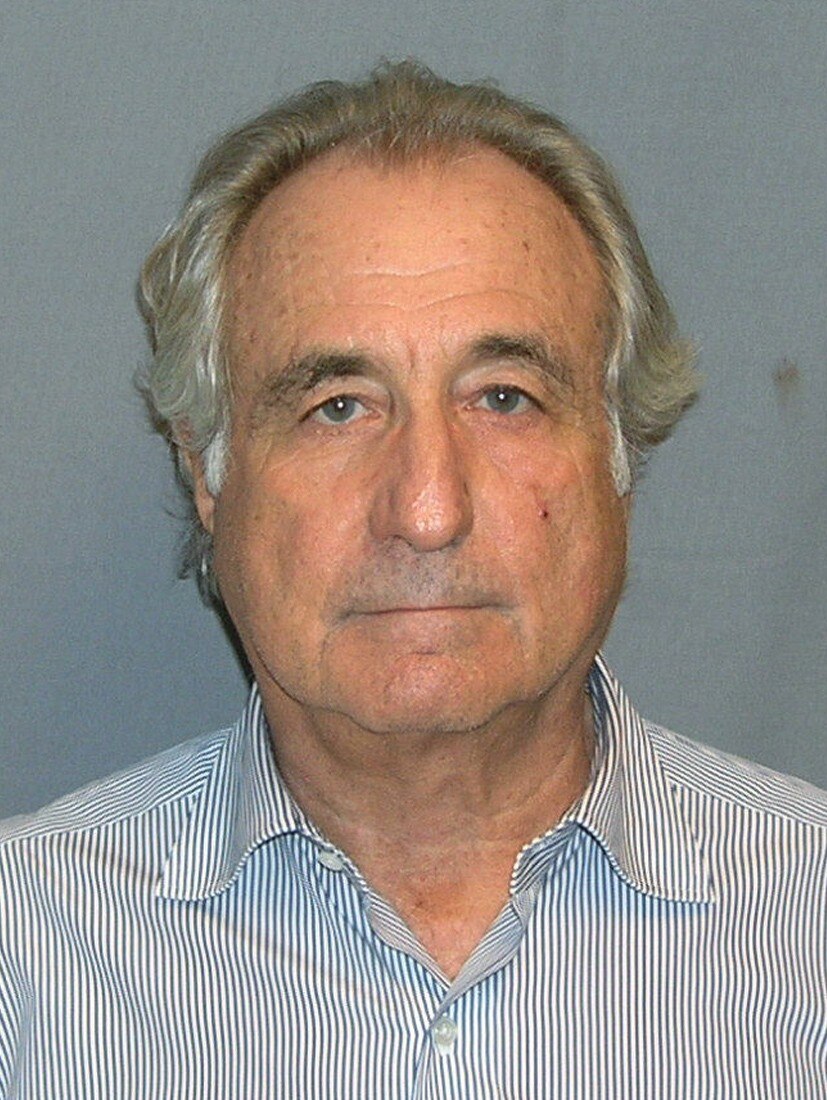
The Split-Strike Illusion
Madoff's advisory business claimed to employ a strategy known as split-strike conversion — sometimes called a "collar." In theory, the approach involved purchasing a basket of S&P 100 stocks, selling out-of-the-money call options against them to generate income, and buying out-of-the-money put options to limit downside risk. Executed properly, such a strategy would produce moderate but relatively stable returns, somewhat dampened in strong bull markets and partially protected in downturns.
What Madoff reported, however, defied what any legitimate implementation of this strategy could achieve. His fund claimed annualized returns of 10% to 12% with remarkably little volatility — only seven losing months across more than 17 years of reported performance through the early 2000s. In a market that suffered the dot-com crash, the September 11 aftermath, and multiple corrections, Madoff's line on the performance chart moved upward with an almost mechanical steadiness that no options-based equity strategy could replicate Markopolos (2010).
No actual trading took place. Client deposits went into a single account at JPMorgan Chase — formerly Chase Manhattan Bank — where the money sat. When clients requested withdrawals, Madoff simply paid them from the pool of deposits. When new money exceeded redemptions, the surplus accumulated. Fabricated trade confirmations and monthly statements, generated by a small team operating IBM AS/400 computers on the seventeenth floor, maintained the fiction. For at least two decades — and possibly since the 1970s — every reported trade was invented.
The Cassandra of Boston
Harry Markopolos, a financial analyst and portfolio manager at Rampart Investment Management in Boston, first encountered Madoff's reported returns in 1999 when his bosses asked him to replicate the strategy. Within hours, Markopolos concluded that the returns were mathematically impossible. He spent the next five months building a detailed analysis and, in May 2000, submitted his first complaint to the SEC's Boston office.
His argument was straightforward and devastating. Madoff claimed to be trading S&P 100 options in volumes that exceeded the entire open interest of the options market — there simply were not enough options contracts in existence for Madoff to execute the strategy he described. Additionally, the statistical pattern of his returns bore no resemblance to any known options strategy. Returns moved in a smooth upward line regardless of market conditions, a signature consistent with fabrication rather than trading.
Over the next eight years, Markopolos submitted increasingly urgent warnings to the SEC — in 2001, 2005, 2007, and 2008. He titled one submission "The World's Largest Hedge Fund is a Fraud." He provided mathematical proofs, identified the feeder fund network, and laid out the two possible explanations: Madoff was either front-running his brokerage clients' orders or running a Ponzi scheme. Markopolos later testified before Congress that he feared for his physical safety during this period, believing that the scale of money involved made violence a real possibility.
SEC staff examined Madoff's operations on at least five occasions between 1992 and 2008. Each time, they failed to take the single step that would have ended the fraud immediately: contacting the Depository Trust & Clearing Corporation or any independent counterparty to verify whether Madoff was actually executing trades. Instead, examiners accepted documents Madoff provided and relied on his explanations. His stature on Wall Street — three terms as NASDAQ chairman, a respected firm, powerful friends — created an aura of legitimacy that regulators never penetrated.
The Feeder Fund Network
Madoff did not market his fund directly to most investors. Instead, he cultivated a network of feeder funds and intermediaries who raised capital in exchange for access and fees. These feeders gave the scheme its global reach and created layers of separation between Madoff and the individuals whose money he was stealing.
Fairfield Greenwich Group, run by Walter Noel, funneled approximately $7.2 billion to Madoff and collected hundreds of millions in fees for doing so. Tremont Group Holdings directed roughly $3.3 billion his way. Banco Santander's Optimal Investment Services sent $2.9 billion. HSBC, Nomura Holdings, BNP Paribas, and numerous European private banks all maintained significant exposure through various feeder arrangements.
| Feeder Fund / Institution | Estimated Exposure |
|---|---|
| Fairfield Greenwich Group | $7.2 billion |
| Tremont Group Holdings | $3.3 billion |
| Banco Santander (Optimal) | $2.9 billion |
| Bank Medici (Austria) | $2.1 billion |
| Ascot Partners (Ezra Merkin) | $1.8 billion |
| HSBC | $1.0 billion |
| Nomura Holdings | $0.3 billion |
Many feeder fund managers charged their own clients management fees and performance fees atop Madoff's operations, yet performed little or no independent due diligence. Fairfield Greenwich claimed to conduct rigorous oversight of Madoff's trading activity. In reality, its due diligence consisted largely of accepting the fabricated documents Madoff produced. Some feeders — particularly Ezra Merkin's Ascot Partners — did not even disclose to their investors that the money was being placed with Madoff, presenting the returns as their own.
Unraveling in the Storm
Madoff's scheme survived for decades because inflows consistently exceeded outflows. As long as enough new money entered the system, he could honor redemption requests. The 2008 financial crisis destroyed that equilibrium.
As markets plummeted in the fall of 2008, panicked investors rushed to liquidate their holdings. Redemption requests to Madoff's fund surged to approximately $7 billion in November and early December — far more than the available cash. For the first time, the scheme could not pay. Madoff attempted to raise new capital from existing clients, telling at least one investor he needed to "ichiban" — restructure — his operations. It was not enough.
On December 10, 2008, Madoff confessed to his two sons, Mark and Andrew, that the investment advisory business was a fraud — a massive Ponzi scheme that he estimated at $50 billion (later revised to $64.8 billion in fabricated account statements). Mark and Andrew contacted a lawyer, who reported Madoff to the FBI. The following morning, FBI agents arrested Bernard Madoff at his Upper East Side apartment. When asked if there was an innocent explanation, Madoff reportedly replied that there was none.
The Scale of Destruction
Paper losses on client statements totaled $64.8 billion — the figure Madoff himself initially cited. Actual cash losses — the difference between what investors deposited and what they withdrew — amounted to approximately $17.5 billion Henriques (2011). Roughly 37,000 victims across 136 countries were affected.
Among the most prominent casualties: the Elie Wiesel Foundation for Humanity, which lost virtually its entire $15.2 million endowment. Steven Spielberg's Wunderkinder Foundation lost an undisclosed but reportedly substantial sum. Yeshiva University lost $110 million. Hedge fund Fairfield Sentry, the largest Madoff feeder, saw its $7.2 billion in reported assets evaporate. Philanthropist Carl Shapiro, one of Madoff's earliest investors, lost an estimated $545 million. European banks including Santander, BNP Paribas, and HSBC collectively lost billions.
Not all victims lost everything. Investors who had withdrawn more than they deposited over the years — so-called "net winners" — had effectively been paid with other victims' money. Those who had deposited money but never taken enough out — "net losers" — bore the heaviest burden. Some had placed their entire life savings, retirement funds, and charitable endowments with Madoff, trusting his decades-long track record.
Human costs extended beyond dollar figures. At least two suicides were directly linked to Madoff losses. Thierry Magon de la Villehuchet, a French investor who had placed $1.4 billion of client money with Madoff through his Access International fund, was found dead in his Manhattan office on December 22, 2008, having taken his own life. Mark Madoff, who along with his brother had reported their father to the FBI, hanged himself on December 11, 2010 — the second anniversary of his father's arrest.
Justice and Recovery
On March 12, 2009, Madoff pleaded guilty to 11 federal felony charges, including securities fraud, wire fraud, money laundering, and perjury. He did not cooperate with investigators and offered no meaningful explanation for why the fraud had continued for so long. On June 29, 2009, Judge Denny Chin sentenced Madoff to 150 years in federal prison — the maximum allowed — calling the fraud "extraordinary evil." Madoff died in a federal medical facility in Butner, North Carolina, on April 14, 2021, at the age of 82.
Irving Picard, the court-appointed trustee for the liquidation of Madoff's firm under the Securities Investor Protection Act, launched one of the most aggressive clawback campaigns in legal history. Picard's approach was methodical: he pursued net winners — those who had withdrawn more than they invested — on the theory that their profits had come directly from other victims' deposits. His largest settlement came from the estate of Jeffry Picower, a longtime Madoff investor whose accounts showed withdrawals exceeding deposits by $7.2 billion. Picower's widow settled for $7.2 billion in 2010, the single largest forfeiture in Department of Justice history at that time.
By 2024, Picard had recovered more than $14.7 billion of the $17.5 billion in actual losses — a recovery rate exceeding 84% that astonished legal observers. More than 1,000 lawsuits in multiple countries contributed to the total. For many victims, the recovery was meaningful but came years or decades after the loss, and the emotional damage could not be repaired with a check.
Systemic Failures and Reforms
What made the Madoff case uniquely damaging was not merely its scale but what it revealed about the institutions charged with protecting investors. A 2009 report by SEC Inspector General H. David Kotz documented a litany of failures: six substantive complaints received between 1992 and 2008, at least five examinations conducted, and zero successful detections. Examiners lacked the expertise to evaluate Madoff's purported options strategy. Investigative tips were assigned to junior staff. At no point did anyone at the SEC contact an independent third party to confirm that trades had actually occurred — a step that would have ended the fraud in minutes.
Madoff also exploited the SEC's fragmented structure. Complaints went to different offices in Boston, New York, and Washington, with no mechanism to aggregate them into a coherent picture. He maintained personal relationships with SEC officials and cultivated an image of cooperation and transparency that disarmed scrutiny. As Enron's collapse had demonstrated seven years earlier, reputational capital could serve as camouflage for fraud on a massive scale.
In the aftermath, the SEC undertook significant internal reforms. It created the Division of Risk, Strategy, and Financial Innovation to improve analytical capabilities. It restructured its examination program to focus on higher-risk advisers. It established a centralized tips and complaints system to prevent the kind of fragmentation that had allowed Madoff's warnings to fall through cracks. Congress passed the Dodd-Frank Act in 2010, which among its many provisions expanded whistleblower protections and created financial incentives for individuals who reported securities violations SEC OIG Report (2009).
Whether these reforms would catch the next Madoff is unknowable. What the case demonstrated with painful clarity is that regulatory frameworks built on trust — trust in self-reported data, trust in the reputation of market participants, trust that professionals will conduct due diligence — contain a fundamental vulnerability. When someone is willing to fabricate everything from trade confirmations to account statements, the entire edifice of verification must rest on independent confirmation, not on the word of the person being examined. Madoff exploited the gap between those two things for at least twenty years, and no one with the authority to stop him ever bothered to check.
Related
Market Histories Learn more about our methodology.