From Fishing Boats to Global Finance
Iceland is a volcanic island in the North Atlantic with a population, in 2008, of roughly 320,000 — about the size of a mid-sized American city. For most of its modern history, the economy revolved around fishing. Cod and haddock built the nation's wealth, and the Icelandic krona rose and fell with the global price of seafood. It was a stable, prosperous, but fundamentally small economy — its entire GDP in 2007 was approximately $20 billion.
Within the span of five years, this tiny fishing nation became home to the most overleveraged banking system in world history. By the time the edifice collapsed in October 2008, the combined assets of Iceland's three largest banks — Kaupthing, Landsbanki, and Glitnir — had reached approximately $182 billion, nearly ten times the country's annual economic output (Benediktsdottir, Danielsson, and Zoega, 2011). No sovereign nation had ever produced such a grotesque mismatch between the size of its financial sector and the economy that was supposed to backstop it.
The collapse, when it came, took just one week. All three banks failed between October 6 and October 9, 2008. Iceland became the first Western European country to request an International Monetary Fund bailout since Britain in 1976. The krona lost half its value. Inflation surged past 18%. Angry citizens banged pots and pans outside parliament until the government fell. And in the rubble of the disaster, a country of 320,000 people was left to decide whether its taxpayers should compensate hundreds of thousands of foreign depositors who had been lured by high interest rates into accounts at Icelandic banks they had never visited.
The Privatization That Started It All
The seeds of catastrophe were planted in 2003, when Iceland completed the privatization of its two state-owned banks, Landsbanki and Bunadarbanki (which later merged into part of Kaupthing). The process was controversial from the start. Both banks were sold to politically connected investors with limited banking experience. Landsbanki went to a group led by Bjorgolfur Gudmundsson and his son Bjorgolfur Thor Bjorgolfsson — the latter already Iceland's only billionaire, having made his fortune in Russian telecommunications and brewing. Bunadarbanki was acquired by a group close to the Independence Party.
Privatization unleashed ambitions that were wildly disproportionate to Iceland's size. The new owners and their hand-picked executives — men in their thirties and forties who became known as the "Viking Raiders" — saw no reason why Icelandic banks should be confined to a market of 320,000 people. Cheap credit was abundantly available in global wholesale markets. European banking regulations, under the EU's single passport system, allowed a bank licensed in one European Economic Area country to operate freely across all others. Iceland, though not an EU member, participated in the EEA. The doors to the continent were open.
The Viking Raiders
Between 2003 and 2008, the three banks expanded at a pace that should have alarmed regulators from Reykjavik to London. Kaupthing acquired the Danish bank FIH Erhvervsbank, the British investment firm Singer & Friedlander, and stakes in Scandinavian financial institutions. Landsbanki's owners purchased the West Ham United football club, the Hamleys toy store chain, and stakes in British retailers including House of Fraser and Debenhams. Glitnir bought Norwegian brokerage firms and expanded aggressively into Scandinavian corporate lending.
The growth was staggering. Between 2004 and 2008, the combined balance sheet of the three banks expanded from roughly 100% of Iceland's GDP to approximately 1,000% — a tenfold increase in four years (Danielsson, 2009). To put this in perspective, even the largest banking systems in the world — those of Switzerland, the United Kingdom, and Ireland — operated with assets of roughly three to five times their national GDPs. Iceland's banks were in a category entirely their own.
| Bank | Assets at Peak (2008) | Multiple of Iceland's GDP |
|---|---|---|
| Kaupthing | $77 billion | ~3.9x |
| Landsbanki | $50 billion | ~2.5x |
| Glitnir | $55 billion | ~2.8x |
| Combined Total | $182 billion | ~9.8x |
Funding this expansion required enormous quantities of borrowed money. The banks could not possibly finance their growth from Icelandic deposits alone — there were only 320,000 people in the country. Instead, they relied heavily on short-term wholesale funding from European and American capital markets: bonds, commercial paper, and interbank loans. This made them acutely vulnerable to any disruption in global credit markets. When confidence evaporated, the funding would vanish with it.
The Carry Trade and the Illusory Boom
Iceland's central bank, Sedlabanki, maintained unusually high interest rates throughout the mid-2000s to combat inflation that was being driven, ironically, by the very credit boom the banks were creating. The policy rate reached 15.5% by early 2008. This enormous interest rate differential attracted global carry-trade speculators — investors who borrowed in low-interest currencies like the Japanese yen or Swiss franc and deposited the proceeds in high-yielding Icelandic krona assets.
Capital flooded into Iceland. The krona appreciated dramatically, making Icelanders feel wealthier than they actually were. Imports surged. Real estate prices in Reykjavik doubled between 2003 and 2007. Icelanders borrowed aggressively — household debt reached 213% of disposable income by 2008 (Olafsson and Vignisdottir, 2012). Many of these loans were denominated in foreign currencies, which seemed rational when the krona was strong but would prove devastating when it collapsed.
The apparent prosperity was dizzying. Reykjavik saw a construction boom. Luxury car dealerships opened. Young Icelandic financiers were profiled in international business magazines. GDP per capita was among the highest in the world. Few questioned whether a sustainable economy could really be built on a banking sector that dwarfed the nation by a factor of ten.
Icesave and the Warning Signs
A market tremor in early 2006 — sometimes called the "mini-crisis" or "Geyser crisis" — offered a preview of what was to come. Fitch downgraded its outlook on Iceland, and credit default swap spreads on the banks widened sharply. The krona fell 20% in a matter of weeks. Analysts at Danske Bank published a widely read report warning that Iceland resembled an emerging-market economy heading for a hard landing.
Rather than reining in their ambitions, the banks adapted. Landsbanki launched Icesave in October 2006 — an online savings product that offered British depositors interest rates well above what domestic UK banks were paying. It was a brilliantly simple solution to the banks' funding problem: instead of relying on skittish wholesale markets, they could tap retail deposits from ordinary savers who were attracted by high returns and who believed their money was protected by deposit insurance.
By the time of the collapse, Icesave had attracted over 300,000 depositors in the United Kingdom and approximately 125,000 in the Netherlands, with combined deposits of roughly 6.7 billion euros. Kaupthing launched a similar product called Kaupthing Edge in several European countries. The banks were importing deposits from across Europe into a financial system that the Icelandic state — with its $20 billion economy and 320,000 taxpayers — could never hope to guarantee.
The Week Everything Collapsed
As the 2008 global financial crisis intensified following the collapse of Lehman Brothers on September 15, Iceland's banks found themselves locked out of the wholesale funding markets they depended upon. The Icelandic government, recognizing the danger, attempted to secure emergency credit lines from foreign central banks. The European Central Bank refused. The Federal Reserve refused. Even the Nordic central banks, Iceland's closest neighbors, offered only limited assistance.
On September 29, the Icelandic government announced a surprise move: it would nationalize Glitnir, acquiring a 75% stake. The announcement, intended to reassure markets, had the opposite effect. Investors concluded that if the government was stepping in, the situation must be far worse than anyone had acknowledged. Credit default swap spreads on the other two banks exploded.
Events then cascaded with terrifying speed. On October 6, Prime Minister Geir Haarde addressed the nation on television, concluding his remarks with an extraordinary appeal: "God bless Iceland." The following day, the Icelandic parliament passed emergency legislation granting the Financial Supervisory Authority (FME) sweeping powers to seize failing banks. On October 7, the FME took control of Landsbanki. On October 8, the British government — led by Chancellor Alistair Darling and Prime Minister Gordon Brown — invoked the Anti-Terrorism, Crime and Security Act of 2001 to freeze Landsbanki's assets in the United Kingdom, placing an Icelandic bank on the same legal list as Al-Qaeda and the Taliban.
The use of anti-terrorism legislation against a NATO ally caused a diplomatic crisis that would poison relations between the two countries for years. Icelanders were outraged. On October 9, the FME seized Kaupthing, the last bank standing. In the space of three days, the entire Icelandic banking system had ceased to exist.
The Diplomatic Fallout and the Icesave Dispute
Gordon Brown's decision to use anti-terrorism powers was driven by genuine panic — the Northern Rock crisis a year earlier had demonstrated the political costs of failing to protect British depositors. But the diplomatic damage was severe. Iceland's president, Olafur Ragnar Grimsson, compared the British action to a military invasion. The Icelandic flag was lowered to half-mast at government buildings.
At the heart of the dispute lay a question with no easy answer: who should pay to compensate the 300,000 British and 125,000 Dutch depositors who had put their savings into Icesave accounts? Under EU deposit guarantee directives, the home country of a bank — in this case Iceland — bore primary responsibility for insuring deposits up to a minimum threshold. But the sums involved were astronomical relative to Iceland's economy. The total Icesave liability was estimated at roughly $5 billion — equivalent to approximately 50% of Iceland's GDP at the collapsed exchange rate.
The British and Dutch governments compensated their own citizens and then presented Iceland with the bill. Two repayment agreements were negotiated with the Icelandic government, and both were put to national referendums. In March 2010, Icelandic voters rejected the first agreement by 93% to 1.8%. In April 2011, they rejected a revised agreement by 60% to 40%. The message was unambiguous: the citizens of a nation of 320,000 would not accept responsibility for the debts of private banks, no matter what diplomatic pressure was applied.
The EFTA Court settled the matter in January 2013, ruling that Iceland had not violated its obligations under the EEA deposit guarantee directive. The proceeds from the winding-up of Landsbanki's estate ultimately covered most depositor claims, vindicating Iceland's refusal to accept sovereign liability for private bank debts.
The IMF and the Unorthodox Recovery
In November 2008, Iceland became the first Western European country since the United Kingdom in 1976 to enter an IMF program. The fund approved a $2.1 billion stand-by arrangement, supplemented by bilateral loans from Nordic countries and Poland totaling an additional $2.5 billion.
Iceland's response to the crisis diverged sharply from the approach taken by most other countries. Rather than bailing out the banks, Iceland let them fail. The FME split each bank into a "new" domestic bank — which inherited deposits, mortgages, and domestic operations — and an "old" bank that held the foreign assets and liabilities. Foreign creditors were left to recover what they could from the old banks' estates. Domestic depositors were fully protected. The logic was brutally simple: Iceland's economy was too small to absorb the banks' foreign losses, and the taxpayers who had never voted for the banks' overseas expansion should not bear the cost.
Capital controls were imposed immediately — Icelanders could not move money out of the country, and foreign investors holding krona-denominated assets were trapped. These controls, initially intended as a temporary measure, remained in place until March 2017 — nearly nine years.
The krona's collapse, while devastating for anyone with foreign-currency debts, functioned as a powerful economic adjustment mechanism. Icelandic exports — fish, aluminum, and increasingly tourism — became far cheaper on world markets. Tourism arrivals surged from roughly 500,000 in 2008 to over 2.3 million by 2017, transforming the industry into Iceland's largest source of foreign exchange.
Prosecuting the Bankers
Perhaps the most remarkable aspect of Iceland's response was its decision to prosecute senior banking executives — something no other country did in the wake of the 2008 global financial crisis. A special prosecutor's office investigated the conduct of executives at all three banks. Dozens of bankers and financiers were charged with market manipulation, breach of fiduciary duty, and fraud.
Convictions followed. Kaupthing's CEO Hreidar Mar Sigurdsson and chairman Sigurdur Einarsson were sentenced to prison. Landsbanki's CEO Sigurjon Arnason was convicted. Glitnir's former CEO Larus Welding received a prison sentence. In total, over twenty-five bankers and financiers were convicted and sentenced to prison terms — a record unmatched by any other country affected by the global financial crisis (Johnsen, 2014).
Ireland's Mirror Image
Iceland's crisis offers an illuminating comparison with Ireland, which faced a similar banking catastrophe at almost exactly the same time. Ireland's banks had also expanded recklessly, fueling a property bubble of epic proportions. When the crisis hit, however, Ireland's government chose the opposite path: on September 30, 2008, it issued a blanket guarantee covering all liabilities of its six major banks — a commitment that eventually cost Irish taxpayers approximately 64 billion euros and transformed a banking crisis into a sovereign debt crisis. Ireland was forced into an EU-IMF bailout of its own in November 2010.
| Metric | Iceland | Ireland |
|---|---|---|
| Bank assets to GDP (peak) | ~10x | ~4.5x |
| Government response | Let banks fail | Full bank guarantee |
| Foreign creditor losses | Substantial | Minimal |
| IMF program | Yes (2008) | Yes (2010) |
| GDP recovery to pre-crisis level | 2015 | 2014 |
| Banker prosecutions | 25+ convicted | 1 convicted |
Iceland's GDP contracted sharply in 2009 and 2010 — falling roughly 10% from peak to trough. Unemployment, previously negligible in a country accustomed to near-full employment, rose to 9%. But the recovery was faster than almost anyone expected. Growth returned in 2011. By 2015, GDP had surpassed its pre-crisis peak. Unemployment fell back below 3% by 2016.
The Kitchenware Revolution
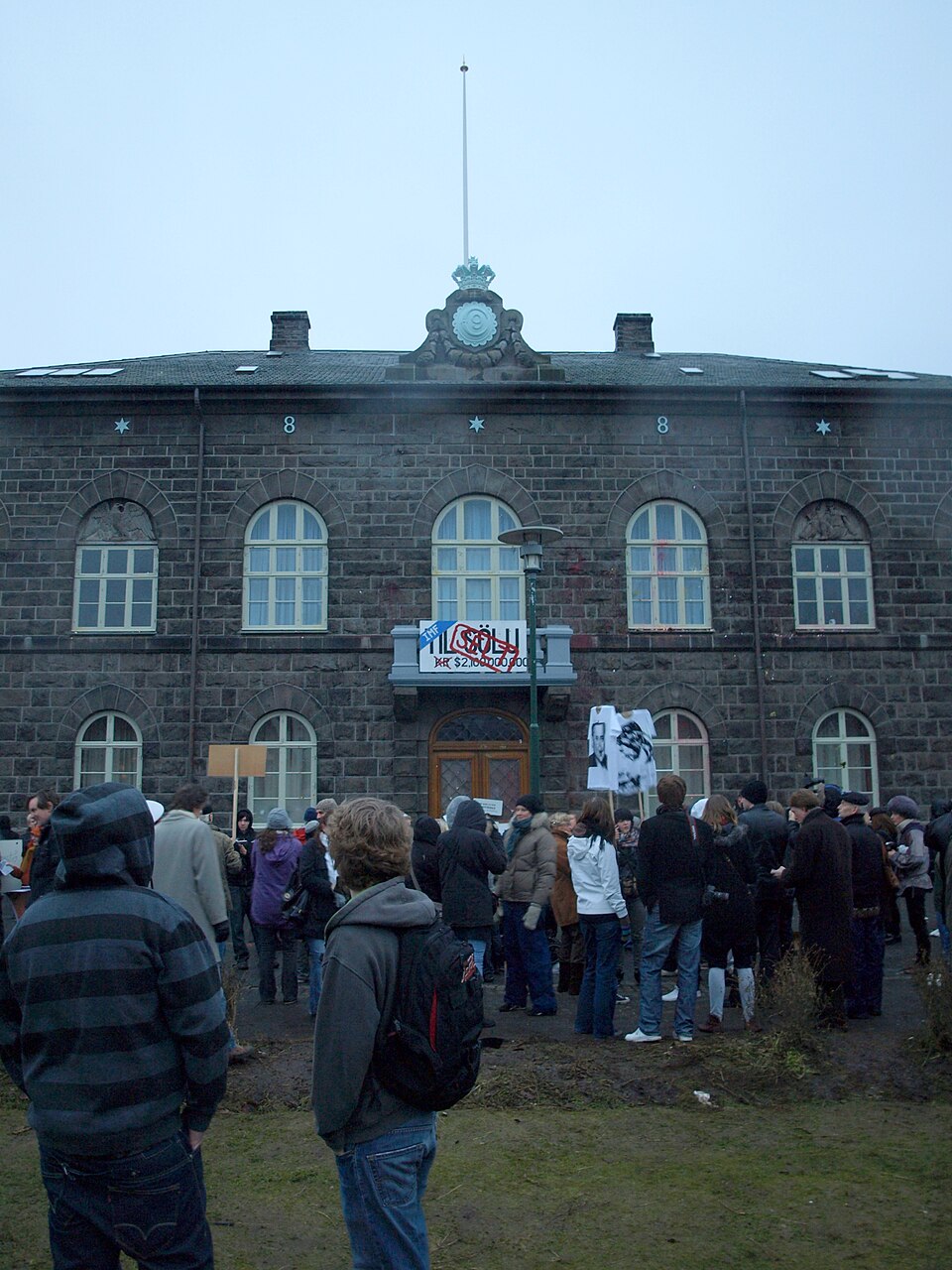
The political consequences were immediate and dramatic. Beginning in October 2008, thousands of Icelanders gathered outside the Althingi — the national parliament, one of the oldest in the world — to demand accountability. Protesters banged pots, pans, and kitchen utensils, giving the movement its name: the "kitchenware revolution" (buslaabyltingin). The protests intensified through the winter, growing in size and anger.
In January 2009, Prime Minister Geir Haarde's coalition government collapsed — the first government in the world to fall as a direct consequence of the financial crisis. A caretaker government led by Johanna Sigurdardottir, Iceland's first female prime minister and the world's first openly gay head of government, took power and called early elections. Haarde himself was later indicted by the Althingi for negligence in office — the first such prosecution of a head of government in modern Icelandic history, though he was ultimately convicted on only a minor charge.
Legacy: Too Small to Bail
Iceland's banking crisis introduced a concept that served as a mirror image to the "too big to fail" doctrine that dominated the global financial crisis elsewhere. Iceland's banks were not too big to fail in the sense that regulators feared their collapse would destroy the global system. They were, however, far too big for the Icelandic state to save. A country with a GDP of $20 billion could not possibly guarantee $182 billion in bank assets. The result was "too small to bail" — the banks were allowed to fail not because policymakers believed in the principle of moral hazard, but because they had no other choice.
Capital controls, while economically distortionary and deeply unpopular, prevented the kind of capital flight that might have turned a banking crisis into a complete economic collapse. The krona's devaluation, painful as it was, provided a competitive adjustment that countries locked into the euro — like Greece and Ireland — could not access. And the decision to protect domestic depositors while imposing losses on foreign creditors, though it damaged Iceland's reputation in international capital markets, preserved the basic functioning of the domestic economy.
What Iceland demonstrated, in the most extreme possible circumstances, was that letting banks fail need not be synonymous with economic ruin — provided the state ring-fences the domestic economy, allows its currency to adjust, and is willing to accept temporary isolation from global capital markets. It was an accidental experiment in crisis management, born of necessity rather than ideology, and its results continue to inform debates about banking regulation, sovereign responsibility, and the proper relationship between a nation's financial sector and the economy it is supposed to serve.
The capital controls were finally lifted in March 2017, nearly nine years after they were imposed, closing one of the strangest chapters in modern financial history — the story of a country with fewer people than Coventry whose banks tried to conquer Europe, and whose citizens, armed with kitchen utensils, refused to pay for the wreckage.
Related
Historical records Learn more about our methodology.