The Kipper und Wipper: Thirty Years War Coinage Debasement
In March 1621, a Nuremberg pamphleteer watched a farmer refuse a handful of newly minted Kreuzer and walk out of the market with his grain still on the cart. The coins looked like silver. They rang like silver on the counter. But their edges were soft, their weight too light, and when a money-changer set them on a balance beside an older Reichstaler struck under Rudolf II, the scale tipped the way the pamphleteer knew it would. "Das Geld ist bös geworden" — the money has turned bad — he wrote that week, and the phrase stuck to the crisis that now had a name: the Kipper- und Wipperzeit.
The words came from the motions the money-changers used in the act of fraud. Kippen meant to tip the scale — rocking the balance to separate full-silver coins out of a handful of mixed currency. Wippen described the see-saw of the pan as good coins were traded for debased ones. Within two years the verbs had become a noun, and the noun had become a description of what happened to the coinage of the Holy Roman Empire between 1619 and 1623 when princes on every side of the opening Thirty Years War discovered that the cheapest way to raise an army was to melt their subjects' savings.
A fragmented monetary system walks into a war
The Empire that Ferdinand II inherited in 1619 was a jurisdictional quilt. Three hundred and more polities — ecclesiastical principalities, imperial free cities, secular duchies, margraviates, bishoprics — held some version of Münzrecht, the right to mint coin. The 1559 Reichsmünzordnung, renewed in 1566, had tried to impose a shared standard: the Reichstaler at 25.98 grammes with a silver fineness of 889 parts per 1000, and a graded structure of fractional coins beneath it. Compliance was nominal. Auditing was left to the imperial Kreis districts, which in practice meant that compliance depended on whether the next-door ruler felt like checking.
The Bohemian revolt of May 1618 and the Battle of White Mountain in November 1620 turned what had been a lax system into a lethal one. Ferdinand II needed cash to pay the army of the Catholic League. The Protestant Union needed cash to pay its own mercenaries. The Elector of Saxony needed cash to hedge both sides. None of them could raise taxes fast enough. None could borrow fast enough — the Fugger and Welser banks of Augsburg, once Europe's largest, had contracted sharply after the Spanish defaults of 1557 and 1575 and were no longer willing to underwrite large sovereign campaigns (Rossi, 2013). What princes could do, instantly, was open new mints.
The Heckenmünzen and the mechanics of debasement
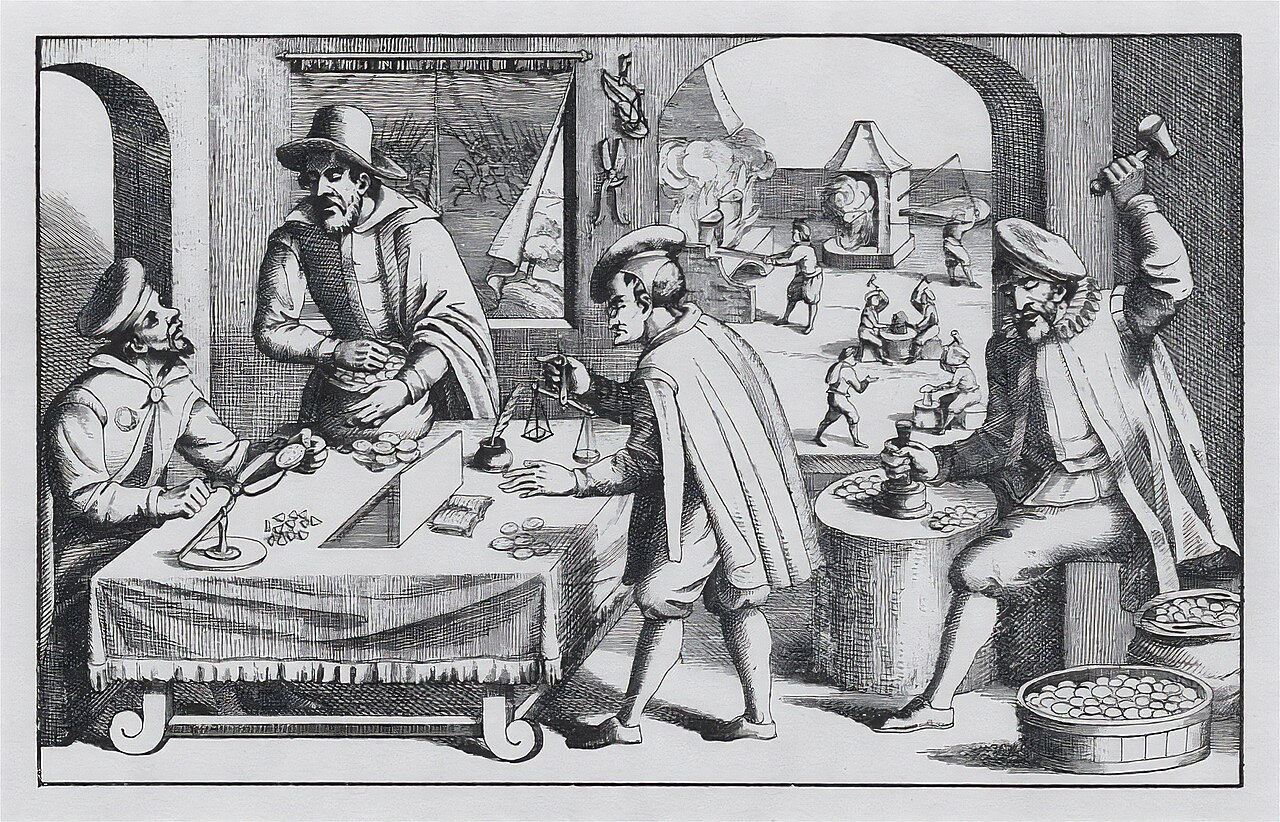
A Heckenmünze — literally a hedge-mint — was a small stamping facility set up in a remote village, often inside a privately owned lodge or monastery, far from imperial inspectors. The technique was straightforward. Agents bought up full-silver Reichstaler and Groschen in the open market using the prince's new coin. They carried the good coin to the hedge-mint. There it was melted, alloyed with copper at ratios that eventually reached five parts copper to one part silver, and restruck as nominally equivalent Kreuzer and Dreibatzen. The debased coin was then spent across the border into the neighbouring territory, which used it to pay its own soldiers, which pushed it further into its own neighbours' hands, and so on.
The flow was one-directional because Gresham's Law ran through the system like a tide. Good coins — full-silver Taler struck before 1618 — vanished from circulation almost instantly in the zones most exposed to debasement. Hoarders pulled them under floorboards. Merchants refused to hold them. Goldsmiths melted them into bullion. Volckart (Volckart, 2017) reconstructs from Hamburg bill-of-exchange data that by mid-1621 the premium on older Taler over newly minted coin had reached 40 percent, and by the peak of the crisis in mid-1622 it exceeded 100 percent. A Kreuzer that nominally represented one-sixtieth of a Reichstaler was in practice worth between a quarter and a fifth of that.
Source: Schnabel and Shin reconstruction of HRE fractional coinage, adjusted to Reichstaler equivalent
The chart traces the weighted silver content of circulating fractional coinage across the main German mint districts — Saxony, Brandenburg, the Upper Palatinate, Austria, Bohemia, and a selection of hedge-mints in the Erzgebirge. From a pre-war equivalent of about 23 grammes of silver per Reichstaler unit, the real metal content falls off a cliff in 1620-1621, bottoms in late 1622 at roughly a quarter of the imperial standard, and only recovers after the 1623 Reichsmünzordnung revision forces hedge-mints to close.
Peak debasement, 1622
By the summer of 1622, mints from Silesia to the Rhineland were producing coins that contemporary assayers — when they could get samples — found to contain as little as 10 percent silver. A 1622 assay in Leipzig, preserved in the Stadtarchiv, recorded a Dreibatzen struck in a Bohemian hedge-mint that weighed 1.8 grammes and contained, on analysis, 0.19 grammes of silver. Its face value said 15 Kreuzer. Its metal said about 3 Kreuzer.
The consequences arrived in the grain markets first. Augsburg's corn register, partially extant, shows rye prices in Gulden per Malter rising from roughly 3 in 1619 to over 9 by late 1622 — a tripling in three years. Leipzig saw similar moves. Wheat and barley tracked rye. Because wages were paid in the debased new coin while grain was increasingly demanded in either good coin or kind, real urban incomes collapsed. In Frankfurt, bread riots broke out in July 1621. In Magdeburg, crowds attacked a money-changer's shop in August 1622 and killed the proprietor — one of several Wechsler lynchings recorded that year across German lands. A contemporary diarist in Hamburg wrote that "the good Taler has fled into the chests of the rich and the bad has taken its place in the purse of the poor."
Grain prices as a mirror of monetary collapse
The table below uses figures reconstructed by the Allen-Unger European price-history dataset and crosschecked against Kindleberger's working papers. Values are in Gulden per Malter for rye; indexed to 1619 = 100 for comparability.
| Year | Augsburg rye (Gulden/Malter) | Leipzig rye (Gulden/Malter) | Index (1619=100) |
|---|---|---|---|
| 1618 | 2.9 | 2.6 | 94 |
| 1619 | 3.1 | 2.8 | 100 |
| 1620 | 4.7 | 4.2 | 153 |
| 1621 | 7.2 | 6.8 | 236 |
| 1622 | 9.3 | 8.9 | 306 |
| 1623 | 7.1 | 6.4 | 228 |
| 1624 | 4.5 | 4.0 | 146 |
| 1625 | 3.6 | 3.2 | 117 |
The price peak of 1622, then the sharp retracement in 1623-1624, maps exactly onto the metallic collapse in the silver-content chart. Once the hedge-mints shut, prices fell back toward the pre-war level — not because harvests suddenly improved, but because the money supply stopped melting itself.
Contemporary reactions
The Kipper- und Wipperzeit is the first monetary crisis for which we have a dense popular literature. Flugschriften — cheap pamphlets printed on poor rag paper, often four pages long — poured out of Augsburg, Nuremberg, Leipzig, and Hamburg. The surviving corpus runs to several hundred items. Their tone is striking: not bewildered, but furious. Writers understood exactly what was happening and blamed it on named princes, named mints, and named money-changers. One Nuremberg broadsheet from 1621 listed twelve hedge-mints by location and demanded they be burned to the ground.
Theologians joined in. Martin Luther had already written on usury and debasement in the 1520s, but the 1621-1622 Lutheran pamphlets took the polemic further. They framed debasement as theft by the sovereign from his own subjects — a violation of the prince's moral duty to maintain the Münzhoheit as a public trust. The language would reappear almost unchanged in Andrew Dickson White's 1876 treatment of the French assignats and again in Carl Menger's later writings on money as a social institution. Readers tracing the lineage of hard-money thought can follow the same argument forward through the French assignats collapse of 1789-1796 and the Weimar hyperinflation of 1921-1923, where the same rhetoric about debasement as sovereign theft recurs in almost identical form.
The 1623 settlement and its aftermath
The institutional response came through the imperial Kreis system rather than the Emperor himself. In late 1622 and through 1623, the Upper Saxon and Lower Saxon Kreise — political groupings of neighbouring territories — began enforcing mutual audits. Mints that could not demonstrate compliance with the 1559 standard were ordered closed. Ferdinand II, whose own hedge-mints had been among the worst offenders, accepted the settlement because the fiscal advantage of debasement had collapsed: after two years, nobody would accept new coin at face value anyway, so seigniorage had evaporated. A revised Reichsmünzordnung, promulgated in 1623 and subsequently refined, restored the Taler standard and imposed somewhat stricter assaying. Schnabel and Shin (Schnabel and Shin, 2018) argue that this settlement worked not because the rules were stronger but because the Kreise had finally been forced to treat coinage as a coordination problem rather than a fiscal one.
The war, of course, continued. The Kipper- und Wipperzeit did not end the Thirty Years War — that took another twenty-five years and the Peace of Westphalia in 1648. But monetary policy inside the Empire did not relapse to hedge-mint debasement on the same scale. When fiscal strain returned during the later phases of the war, princes turned instead to loans, grain requisitions, and direct extraction from occupied territories.
Why the episode matters
Adam Smith referenced the Kipper- und Wipperzeit in Book IV of The Wealth of Nations as a proof case that debasement is self-limiting: once it is understood by the market, the seigniorage disappears. David Hume drew on it in his 1752 essay Of the Balance of Trade as evidence that bad coin drives good coin abroad — the Gresham principle stated in continental form. Milton Friedman cited Kindleberger's account in his 1992 Monetary Mischief as an early example of how uncoordinated monetary authorities produce inflation even in the absence of a printing press.
Kindleberger himself placed the episode at the root of his broader crisis taxonomy. "The Kipper und Wipper," he wrote, "is to monetary economics what the Black Death is to epidemiology — the first recognisable occurrence of a phenomenon whose later appearances are variations on the original shape" (Kindleberger, 1991). The observation is sharper than it first sounds. Every feature of modern hyperinflation — the velocity spike, the flight to real assets, the urban bread riots, the lynching of intermediaries blamed for the prices, the policy response via institutional coordination rather than fiscal retrenchment — is already present in 1622. Only the instrument is different. Where Weimar printed and Zimbabwe printed, the Kipper- und Wipperzeit melted and restruck.
The contrast with later paper-money crises is worth tracing in both directions. Readers can watch the same mechanism recur with different instruments in the Mississippi Bubble under John Law and at the extreme in the Zimbabwe hyperinflation of 2007-2009, where the same sociology of wage lag, intermediary scapegoating, and institutional collapse replays nearly four centuries after the hedge-mints closed.
A template for central-bank independence arguments
The Kipper- und Wipperzeit also sits uneasily inside the modern case for central-bank independence. The standard argument — that monetary authority must be separated from fiscal authority because sovereigns who control both will use the first to fund the second — is usually illustrated with Weimar or with post-war Latin American inflations. The 1619-1623 episode reaches further back. The problem in the Empire was not that one sovereign controlled both the mint and the treasury; it was that hundreds of sovereigns controlled their own mints and their own treasuries, and competitive debasement inside a shared monetary zone produced an outcome worse than any single sovereign would have chosen unilaterally. Rossi (Rossi, 2013) reads this as the first documented monetary-union failure — four centuries before the euro's designers reached for comparable metaphors about coordination risk.
Exactly three centuries after the Kipper- und Wipperzeit ended, in 1923, the Reichsbank stopped printing marks against commercial paper and the Rentenmark took over. The sociology of the 1622 bread riots in Frankfurt and Magdeburg mirrored the Berlin scenes of November 1923 with a precision that cannot have been accidental — some of the German inflation theorists of the early twentieth century, Gustav Stolper among them, wrote explicitly about the seventeenth-century precedent in their diaries during the Weimar crisis. The Kipper- und Wipperzeit was, in other words, the reference case that Germans themselves reached for when their own money turned bad again.
What the farmer in the Nuremberg market did with his grain in March 1621, we know from the pamphlet: he took it home, buried the surplus, and refused to sell until the coin returned to weight. Most of his neighbours did the same. Within a year the grain supply in the town had fallen by a quarter, not because the harvest failed but because the coinage did. The money had turned bad. The grain had gone into the ground.
Related
Historical records Learn more about our methodology.