A Republic That Could Not Stop Borrowing
In the spring of 1407, the Republic of Genoa was bankrupt — not for the first time, and not yet for the last. French troops occupied the city under Marshal Boucicaut, the Doge had been swept aside, and the Republic's tax revenues had been pledged so many times over to so many groups of creditors that nobody could say what the state actually owed. Some claims dated back to 1149, when Genoese merchants had first lent silver to fund a campaign against Almería. Others were only months old. Each loan had its own administration, its own pool of creditors, its own assigned tax stream, and its own bookkeeping. The Genoese called these pools compere, from comperare — to buy — because investors did not so much lend the state money as buy the right to collect a designated revenue.
On 27 April 1407, the Genoese authorities issued a decree consolidating the largest of these compere into a single institution: the Casa delle Compere e dei Banchi di San Giorgio. What looked like a routine debt restructuring would prove to be one of the most consequential financial innovations of the late Middle Ages. The Casa, named for the city's patron saint, became a permanent corporation owned by its creditors, governed by elected protectors, and empowered to collect the very taxes that funded its dividends. Over the next four centuries it would outlast French occupations, Spanish patronage, and the Republic itself.
From Compere to Consolidation
Genoa had been borrowing from its citizens since the twelfth century in much the same way Venice had pioneered with its prestiti. A war or a galley fleet required cash that ordinary revenues could not produce, so the commune levied a forced loan, the mutuum, on the wealthier citizens, and pledged a specific gabella — a customs duty on wine, on salt, on woollen cloth — to pay interest. A group of creditors received a charter setting out their rights as a compera, with their own consuls, their own seal, and the right to administer the assigned tax until repayment.
By the late fourteenth century the system had multiplied beyond comprehension. Heers's census of surviving Genoese fiscal records identifies more than two hundred separate compere active during the 1380s and 1390s, ranging in size from a few hundred lire to several hundred thousand (Heers, 1961). Each had its own rules. Some paid 7 percent, others 8 or 10. Some used the new Genoese lira, others the older grosso. A creditor who held shares in twelve different compere had to keep track of twelve different interest schedules and twelve different repayment timetables. The cost of administering this thicket was enormous, and the credibility of any individual compera depended on whether the gabella assigned to it was actually being collected.
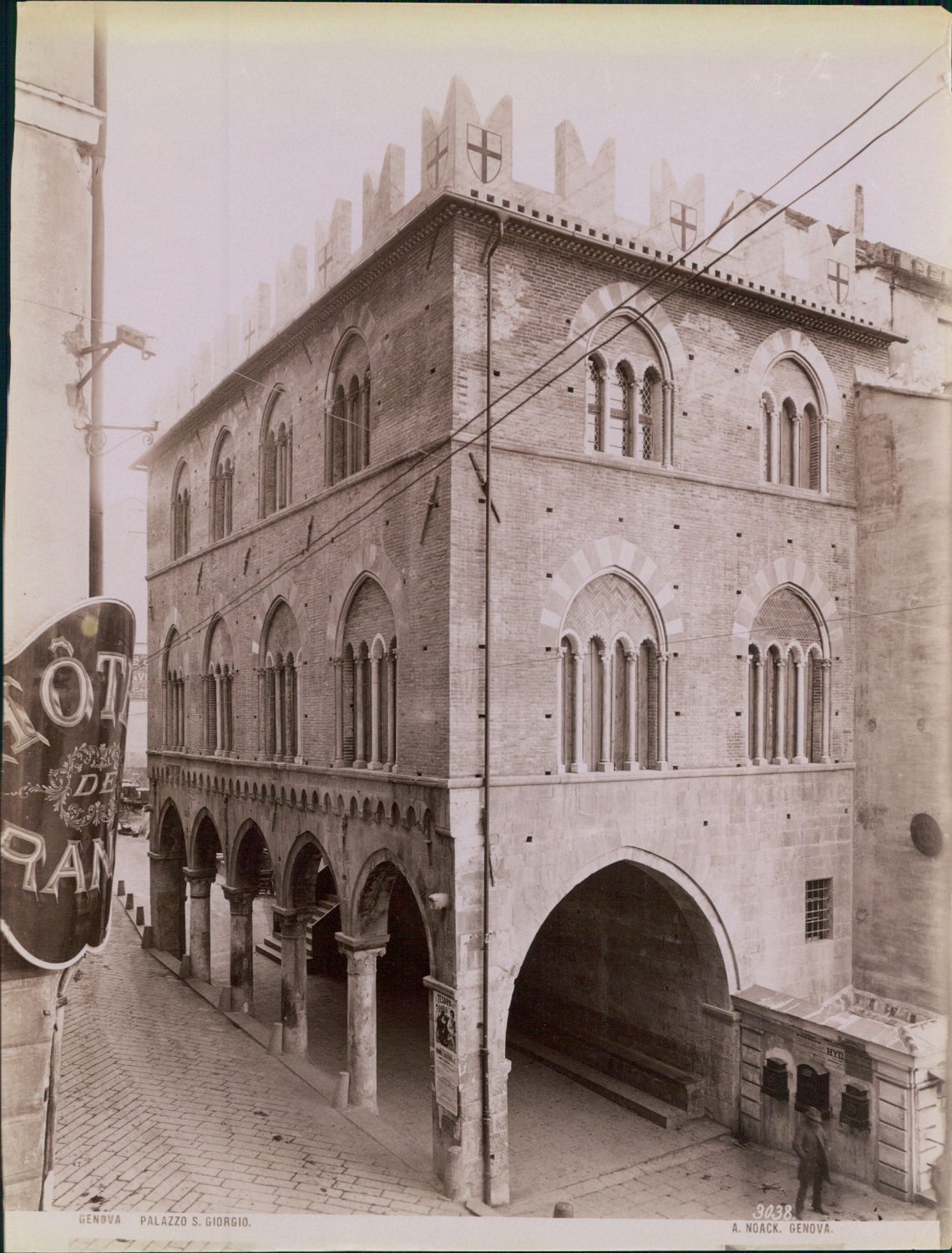
The 1407 consolidation merged the most important of these — the so-called compere antichissime, the most ancient, together with several others created in the 1380s — into a single body. Investors surrendered their old charters in exchange for shares, called luoghi, in the new Casa. Each luogo had a nominal value of 100 lire and paid a variable dividend, the paga, calculated from the net revenues that the Casa collected on the Republic's behalf. The institution's headquarters were established in the old customs house overlooking the port — the Palazzo San Giorgio — which became its physical and symbolic centre.
What the consolidation produced was not merely a tidier balance sheet. It was a new kind of legal person — a creditor-owned corporation with the power to tax, to administer territory, and to govern itself. Felloni's archival work on the early Casa describes its governance in detail: eight protectori, elected annually by an assembly of large luogo-holders, supervised the day-to-day operations; below them sat boards of magistrates handling specific revenue streams, judicial cases involving the Casa's properties, and the administration of its colonies (Felloni, 1991). The Doge of Genoa had no formal authority inside the Palazzo. The Casa was a parallel state, run by the people the Republic owed money to.
The Machinery of Tax-Farming
What did the Casa actually do once it was created? In the simplest terms, it collected the taxes that paid its own dividends. The Republic, having pledged dozens of gabelle and customs duties to the consolidated compere, found it easier to let the Casa collect those revenues directly than to collect them itself and then hand the proceeds over. By 1450 the institution was running the salt monopoly, the customs on imports and exports moving through the port, the duties on weights and measures, the tolls on the river crossings of the Genoese contado, and the salt-export licences for the Riviera coast.
This was tax-farming on a scale that no purely private contractor could have matched. The Casa employed hundreds of clerks, weighers, customs officers, and armed enforcers; it ran courts that tried cases of smuggling and tax evasion; it maintained its own treasury and accounting offices. Citizens who failed to pay duties owed at the docks dealt not with the Genoese state but with officials wearing the Casa's livery. Greif's institutional analysis emphasises the structural logic of this arrangement — by aligning the interests of the largest creditors with the efficient collection of the assigned revenues, the Republic outsourced both the administrative cost and the credibility problem of public finance to a body that had the strongest possible incentive to make the system work (Greif, 2006).
Source: Felloni (1991); Heers (1961)
A secondary market in luoghi developed in the loggias around the Palazzo. Prices fluctuated with the Republic's military fortunes, with the size of the harvests that fed the salt and grain duties, and with the political news from Constantinople or Madrid. By the late fifteenth century, a luogo nominally worth 100 lire might trade for as much as 150 in years when the paga was high, or as little as 70 in years when the colonies were under attack or French troops were once again at the gates. Foreign investors — Florentines, Lombards, even Iberian merchant houses — bought into the Casa, drawn by yields that consistently exceeded what they could earn on Florentine Monte Comune shares.
The Colonies: Caffa, Famagusta, Corsica
In 1453 Constantinople fell to the Ottomans, and the Genoese colonial system in the eastern Mediterranean entered its final crisis. The Republic itself was politically too weak to defend its overseas possessions, but the Casa had the money and the administrative capacity that the state lacked. In a series of transfers between 1453 and 1474, the Casa took over the direct administration of Genoa's most important colonies — first Famagusta on Cyprus, then the Crimean port of Caffa with its dependencies along the northern shore of the Black Sea, and eventually the island of Corsica.
The arrangement was almost without precedent in medieval Europe. A privately governed financial institution now ran sovereign territory. The Casa appointed governors, levied taxes, minted coin in some of the colonies, and conducted limited diplomacy with the surrounding powers. Sieveking's nineteenth-century reconstruction of Casa records describes how the institution's agents in Caffa collected duties on the slave trade and the fur trade, managed the alum mines, and corresponded directly with the Khanate of Crimea about commercial privileges (Sieveking, 1898). When the Ottoman fleet sacked Caffa in 1475, the loss fell on the Casa's balance sheet, not on the Republic's.
The Corsican administration lasted longest and proved the most fraught. The Casa held the island from 1453 to 1562, governing through a system of native magistrates supervised by Genoese officials paid out of Casa revenues. Tax-farming in Corsica generated steady but unspectacular returns, while the cost of suppressing periodic revolts ate into the dividend. In 1562 the Casa surrendered direct administration back to the Republic, having concluded that the cost of governing a rebellious population could no longer be justified by the financial yield.
| Century | Colonies administered | Principal Genoese tax streams collected | Key innovations |
|---|---|---|---|
| 15th | Famagusta (1447-1464), Caffa (1453-1475), parts of the Crimea | Salt monopoly, port customs, weights and measures, wine gabella | Consolidation of compere (1407); first elected boards of protectors; transferable luoghi |
| 16th | Corsica (until 1562), some Aegean possessions | Customs on imports, export duties on woollens, river tolls, salt-export licences for the Riviera | Branches in Madrid and Antwerp; lending to Spanish crown; first formal accounting standards |
| 17th | Coastal fortresses on the Ligurian Riviera | Most major Genoese gabelle; tobacco monopoly; some indirect taxes on land transactions | Standing reserve fund; partial deposit-taking from private clients; secondary luoghi market formalised |
| 18th | Limited; administration mostly devolved back to Republic | Reduced share of state revenues after 1750s reforms | Survived French occupations 1746-1748; held national debt during decline of Republic |
Genoese Bankers and the Spanish Empire
The sixteenth century gave the Casa a new and lucrative role. As Spain's American silver flowed into Europe through Seville, the Habsburg monarchy needed a financial network capable of moving those funds to Antwerp, Milan, and the imperial armies fighting in the Netherlands. Genoese bankers — the so-called nobili nuovi families like the Spinola, the Doria, and the Centurione — became the principal lenders to Philip II and his successors. The Casa was not directly a lender to Madrid, but it was the institutional bedrock on top of which those private bankers operated. Their household credit rested on their luoghi holdings, and their commercial reputation drew on the Casa's solvency.
This was the period that Fernand Braudel famously called "the century of the Genoese" — the years roughly between 1557 and 1627 when the financial fairs at Piacenza, organised by Genoese bankers, set the exchange rates for half of Europe. Fratianni and Spinelli have argued that the Casa during this period functioned as a quasi-central bank in everything but name, providing a stable monetary anchor through its luoghi shares and serving as the lender of last resort to the Genoese private banking houses that dominated European public finance (Fratianni, 2006). The Genoese themselves understood this. A Doge writing to a Spanish ambassador in 1581 noted that "without the Casa, the Republic would be neither rich nor governed" — a frank acknowledgement that the formal state apparatus depended on the institution it was supposed to control.
"A State Within a State"
The most famous summary of what the Casa had become came not from a Genoese but from a Florentine. In the eighth book of his Florentine Histories, completed around 1525, Niccolò Machiavelli paused his account of the wars of the Italian peninsula to describe Genoa's peculiar institutional arrangement. The passage is worth quoting at some length:
"The people of Genoa, having transferred to the Casa di San Giorgio almost all their cities and possessions which obeyed the empire of that Republic, gave it dominion over them and government of them; from this it came that the citizens have abandoned the city itself, as something governed tyrannically, for the Casa, as a thing equitably and well administered. From this came the easy and frequent change of governments in that city, where now a citizen, now a stranger, rules; because it is not the government that defends the Casa, but the Casa that defends the government."
What Machiavelli was registering, with the clarity of an outsider who had studied the place carefully, was the institutional inversion that had occurred. In every other European polity the state taxed its subjects and used the proceeds to fund its operations. In Genoa the Casa taxed the subjects and the state was a residual claimant on whatever the Casa chose to provide. He drew the obvious lesson: "It is an example truly memorable, and one unknown to those ancient philosophers who in all things sought after the best forms of government, to see within one and the same circuit, among the same citizens, liberty and tyranny."
For Machiavelli, who had spent his life thinking about how to build a stable republic, this was both impressive and unsettling. The Casa had achieved the institutional stability he sought, but at the cost of hollowing out the political authority of the formal state. He was not the only contemporary to notice. Francesco Guicciardini made similar observations in his Storia d'Italia, and later writers from Botero to Sarpi treated the Genoese model as a curiosity worth analysing.
Survival Through Conquest
The Casa's most surprising feature was its capacity to outlive every regime that ruled Genoa. The French occupied the city in 1499, again in 1507, and yet again in 1527; Andrea Doria's reorganisation in 1528 placed Genoa under Spanish protection; revolts in 1547 and 1575 reshuffled the patrician oligarchy; the Austrians sacked the city in 1746. Through every upheaval the Casa kept paying its dividends, kept collecting its gabelle, and kept administering its archives.
This survival was not accidental. Each successive occupier had a strong incentive to preserve the institution because each was, in effect, a creditor of it. The luoghi were owned not just by Genoese patricians but by Spaniards, Frenchmen, Milanese nobles, and merchant houses across the Mediterranean. Defaulting on the Casa would have meant defaulting on a politically dangerous list of foreign elites. When Marshal Boucicaut occupied the city in 1407, his administration helped midwife the consolidation rather than confiscate the underlying assets. When Andrea Doria allied Genoa with Spain in 1528, his reforms strengthened the Casa rather than weakening it. The institution that the Republic had created to manage its debts ended up shielding the Republic itself.
The arithmetic mattered too. Felloni's reconstruction of the Casa's balance sheets shows that in most years between 1500 and 1700, the institution's gross revenues exceeded those of the formal Genoese state, often by a wide margin (Felloni, 1991). It had the money, the personnel, the records, and the legal apparatus that any new ruler would need in order to govern; expropriating it would have meant losing the very instrument required to extract value from the city.
Decline and Dissolution
By the eighteenth century the Casa's role had narrowed. Reforms in the 1750s shifted some tax collection back to the Republic, the colonies were long gone, and the rise of newer financial centres in Amsterdam and London had eclipsed Genoa as a hub of European public finance. The Genoese state itself was a fading power, increasingly dependent on the diplomatic protection of larger neighbours. The Casa continued to manage what remained of the consolidated debt, but the institutional creativity of the fifteenth and sixteenth centuries was gone.
The end came with Napoleon. The Republic of Genoa fell in 1797, replaced by the French-sponsored Ligurian Republic; the new regime was less hostile to the Casa than to most surviving ancien-régime institutions, but the political ground had shifted. In 1805 Napoleon formally suppressed the Casa as part of his integration of Liguria into metropolitan France, ordering its assets liquidated and its archives transferred to the new prefecture. A partial revival in 1816 under the restored Sardinian administration lasted only briefly; final closure followed in the same year. After 398 years of continuous operation, the institution simply ceased to exist.
The archives, fortunately, survived. Modern scholars working through the Casa's bond registers, dividend tables, and colonial accounts have been able to reconstruct in granular detail what Genoa's bond bank actually did, decade by decade. That documentary inheritance is itself part of the institution's legacy — few medieval bodies left behind a paper trail of comparable depth.
What the Casa Bequeathed
The line from the Casa di San Giorgio to the modern central bank is not direct. The institution did not issue paper money on a national scale, did not act as a monetary anchor for circulating coinage, and did not see itself in the abstract terms of public-debt management that Anglo-Dutch finance would later develop. Yet the structural insight it embodied — that a sovereign borrows more cheaply and more credibly when its debt is managed by a quasi-independent creditor-controlled institution — became foundational. Adam Smith referenced Genoese practice when discussing public banks in the Wealth of Nations, and the founders of the Bank of Amsterdam in 1609 worked within a Mediterranean tradition the Casa had largely shaped.
There is a sharper parallel as well. The Casa's eight protectori, elected by shareholders to manage tax-farms and colonial administration on behalf of bondholders, look in retrospect like an early sketch of a central bank's board of governors — accountable not to the government whose debt they hold but to the creditors who paid for it. Modern central bank independence, the doctrine that monetary policy works better when delegated to officials insulated from ordinary politics, rests on a similar wager. The Genoese arrived at that wager four centuries before the Bank of England was chartered, and they made it work for nearly four hundred years.
In April 1407, when the protectori first met in the upper hall of the Palazzo San Giorgio to count the consolidated luoghi, they thought they were tidying up a fiscal mess. They were, in fact, building one of the more durable institutions Europe would ever produce — a creditor-owned corporation that taxed the Republic that created it, governed colonies the Republic could not defend, and outlived everything except its own balance sheet.
Related
Historical records Learn more about our methodology.