The Bull Market of the Mid-1980s
Between August 1982 and August 1987, the Dow Jones Industrial Average rose from approximately 776 to a peak of 2,722 — a gain of more than 250 percent in five years. Falling interest rates, deregulation under the Reagan administration, a wave of corporate mergers and leveraged buyouts, and the growing power of institutional investors managing pension and mutual fund assets all fed the rally. Wall Street was booming, and the mood was triumphant.
By the autumn of 1987, cracks had begun to appear beneath the surface. Large and growing trade and budget deficits were putting persistent downward pressure on the dollar. Treasury Secretary James Baker had publicly clashed with West German officials over monetary policy, stoking fears that international economic cooperation was breaking down. In early October, proposed legislation to eliminate tax deductions for interest paid on debt used in corporate takeovers threatened to undermine the leveraged buyout boom — one of the market's most powerful engines. Meanwhile, rising bond yields were making fixed-income investments increasingly attractive relative to equities, draining money from stocks.
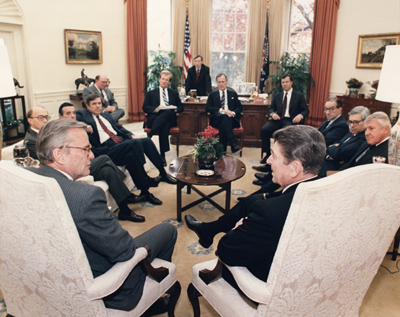
The Deterioration of Mid-October
Five days of accelerating losses set the stage for catastrophe. On Wednesday, October 14, the Commerce Department reported a larger-than-expected trade deficit of $15.7 billion for August, sending the dollar sharply lower and spooking foreign investors in American equities. The Dow fell 95 points that day — 3.8 percent. Thursday brought another 58-point decline. Friday, October 16, was worse: a 108-point drop, 4.6 percent, on what was then record trading volume.
Friday's losses were especially alarming because they accelerated into the close, a pattern that suggested portfolio insurance programs were generating large automatic sell orders. Over the weekend, financial commentators speculated openly about whether the selling would continue. SEC Chairman David Ruder then made an ill-timed public suggestion that a trading halt might be considered if markets fell further — a comment many participants interpreted not as reassurance but as a signal that authorities expected more trouble ahead.
October 19: The Crash
Monday, October 19, 1987, opened into a wall of sell orders that had accumulated over the weekend. The Dow Jones Industrial Average gapped down sharply at the bell, and by 10:00 a.m. it had already shed more than 100 points. No organized intervention materialized — no consortium of major banks stepping in to buy, no institutional cavalry. Selling accelerated through the morning and into the afternoon, wave after wave.
When the closing bell finally rang, the Dow stood at 1,738.74, down 508 points — a 22.6 percent decline in a single session, the kind of extreme volatility event that later motivated the development of volatility-managed strategies. It remains the largest one-day percentage drop in the index's history. The S&P 500 fell 20.5 percent. Approximately 604 million shares traded on the New York Stock Exchange, more than double the previous record, and the NYSE's systems buckled under the strain — order execution delays stretched past an hour in some stocks. Roughly $500 billion in market value vanished in six and a half hours.
| Market | Index | One-Day Decline |
|---|---|---|
| United States | DJIA | -22.6% |
| Australia | All Ordinaries | -41.8% |
| Hong Kong | Hang Seng | -45.8% |
| Singapore | Straits Times | -42.2% |
| United Kingdom | FTSE 100 | -10.8% |
| Canada | TSE 300 | -11.3% |
This was not an American event. Markets in Hong Kong had already fallen 11 percent the preceding Friday and would remain shuttered for the rest of the week. London's FTSE 100 dropped 10.8 percent on Monday — its losses partially contained because the Great Storm of October 15-16 had felled 15 million trees across southern England, disrupted transportation, and forced the London Stock Exchange to close early. In the days and weeks that followed, Australian markets lost 41.8 percent, Hong Kong's Hang Seng shed 45.8 percent for the month, and Singapore's Straits Times Index fell 42 percent.
Portfolio Insurance and the Feedback Loop
In January 1988, the Presidential Task Force on Market Mechanisms — chaired by Nicholas Brady and known as the Brady Commission — delivered its postmortem. At the center of the disaster, the commission found a hedging strategy called portfolio insurance and its toxic interaction with the stock index futures market.
Developed in the early 1980s by UC Berkeley finance professors Hayne Leland and Mark Rubinstein and commercialized through their firm Leland O'Brien Rubinstein Associates, portfolio insurance was built on the Black-Scholes options pricing model. It sought to replicate the payoff of a protective put option by dynamically selling S&P 500 index futures as the market fell and buying them back as it rose — in theory, providing institutional investors like pension funds with a floor on losses while allowing them to capture upside gains.
By October 1987, an estimated $60 to $90 billion in institutional equity assets were managed under portfolio insurance strategies. Every one of these programs responded to falling prices in exactly the same way: by selling index futures. On Black Monday, as stocks declined, the programs generated massive sell orders in the S&P 500 futures pit, driving futures prices well below the theoretical fair value of the underlying stocks and demonstrating the market impact of large orders in devastating fashion. Index arbitrageurs — traders who profit from discrepancies between futures and cash prices — responded by selling stocks on the NYSE floor and buying the cheaper futures, transmitting the selling pressure from Chicago to New York.
A destructive feedback loop locked in. Falling stock prices triggered portfolio insurance selling of futures. Depressed futures prices triggered arbitrage selling of stocks. Lower stock prices triggered more portfolio insurance selling. The Brady Commission concluded that on October 19, just three portfolio insurance strategies accounted for nearly $2 billion in selling, while ten other institutional investors following similar reactive patterns contributed another $1.5 billion.
The Federal Reserve Response
Alan Greenspan had been Federal Reserve Chairman for all of two months when he faced the most severe test of central bank crisis management since the Great Depression. Before markets opened on Tuesday, October 20, the Fed issued a single sentence: it affirmed "its readiness to serve as a source of liquidity to support the economic and financial system." Brief as it was, the statement left no ambiguity — the central bank would not allow the crash to cascade into a broader financial crisis.
Action followed immediately. The Fed injected reserves into the banking system through open market operations while privately pressing major banks to keep extending credit to securities firms, many of which faced acute liquidity crises. E. Gerald Corrigan, president of the Federal Reserve Bank of New York, personally called the heads of major New York banks to ensure that credit lines to broker-dealers remained open. Several specialist firms and market makers on the NYSE floor were teetering on the edge of insolvency; their failure would likely have forced the Exchange to halt trading entirely.
Tuesday, October 20, came terrifyingly close to a second catastrophe. The market dropped another 9 percent in early trading, and the Chicago Mercantile Exchange nearly suspended trading in S&P 500 futures — a move that would have forced the NYSE to follow, potentially triggering a cascade of closures across global markets. Instead, a dramatic late-session rally saw the Dow recover 102 points, closing up 5.9 percent for the day. The immediate crisis had passed, though it left behind an understanding of systemic fragility that would reshape regulation for decades.
Regulatory Reforms and Circuit Breakers
Black Monday's most enduring regulatory legacy was the circuit breaker — an automated mechanism that halts or slows trading when markets decline by specified thresholds. The NYSE implemented its first version in October 1988, initially triggered by 250-point and 400-point drops in the Dow. After the Flash Crash of May 6, 2010, when the Dow plunged nearly 1,000 points in minutes before recovering, the system was overhauled. Modern circuit breakers are percentage-based and operate at three tiers: a 7 percent decline in the S&P 500 triggers a fifteen-minute halt (Level 1), a 13 percent decline triggers another halt (Level 2), and a 20 percent decline halts trading for the remainder of the day (Level 3).
Efforts to improve coordination between equity and futures markets also gained urgency. Before October 1987, these markets had operated with minimal communication. In the aftermath, the SEC and the Commodity Futures Trading Commission established joint surveillance protocols, exchanges implemented cross-market information-sharing systems, and margin requirements in the futures markets were raised to reduce leverage.
Aftermath and Legacy
Unlike the crash of 1929, Black Monday did not precipitate a recession or prolonged downturn. The U.S. economy continued to grow, and the Dow surpassed its pre-crash peak by August 1989 — a recovery widely attributed to the Federal Reserve's swift intervention, which prevented the crash from triggering a cascading failure of financial institutions and a contraction in credit.
That success carried its own consequences. The experience of 1987 profoundly shaped central bank behavior in every subsequent crisis. Greenspan's doctrine of aggressive monetary easing in response to financial dislocations became the template for the 1998 Long-Term Capital Management rescue, the response to the September 11, 2001, attacks, and the 2008 global financial crisis under his successor Ben Bernanke. Critics argued that the approach created moral hazard by encouraging excessive risk-taking, but its origins in Black Monday's successful resolution gave it lasting credibility among policymakers.
Perhaps most significantly, October 19 changed how both regulators and market participants understood systemic risk. Computerized trading strategies — each individually rational — had combined to produce a catastrophic momentum crash when thousands of participants followed identical rules at the same time. It was a warning about what happens when a market full of supposedly independent actors turns out to be running the same playbook. That warning would only grow louder as algorithmic and high-frequency trading came to dominate the decades that followed.
Related
Historical records Learn more about our methodology.