Alexander Hamilton and the Birth of American Credit: How a Dinner Table Bargain Created the US Sovereign Bond Market (1790)
When George Washington took the oath of office on the balcony of Federal Hall in New York on 30 April 1789, the country he now led was, in strict financial terms, bankrupt. Continental dollars from the Revolutionary War had lost more than 99 percent of their value. Federal IOUs issued to soldiers and contractors traded in coffee-house back rooms for pennies on the dollar. Amsterdam bankers who had advanced money to the Continental Congress had not received a full interest payment in years. The thirteen states ran their own competing currencies, their own competing debts, and their own competing customs duties. Rhode Island had begun forcing its creditors to accept depreciated paper money at par, on pain of imprisonment (Sylla, 2011).
Into this wreckage stepped the country's first Secretary of the Treasury — a thirty-four-year-old immigrant from the island of Nevis named Alexander Hamilton. Over the next eighteen months, Hamilton would draft, defend, and in part invent a financial architecture that transformed the United States from a sovereign pariah into a creditworthy nation. The key moment was not a battle or an election. It was a dinner.
The wreckage of 1789
To understand what Hamilton faced, one must grasp just how large and tangled the debt was. The federal government owed roughly $54 million: about $12 million to foreign creditors, mostly Dutch and French, and $42 million to domestic holders of Continental loan-office certificates, army pay certificates, and commissary notes. On top of this, the individual states owed a further $25 million in war-related obligations. That made a total national burden close to $79 million — an enormous figure against an economy whose entire annual output was probably less than $200 million in the early 1790s (Wright, 2008).
Interest alone on these obligations, if paid in full at the original contracted rates, would have consumed nearly the entire projected revenue of the federal government. No existing creditor expected to be paid in full. Most had long since sold their paper at steep discounts to speculators who were betting, against the prevailing pessimism, that some future federal regime might eventually honor something.
| Component of American public debt, 1789–1790 | Approximate face value |
|---|---|
| Foreign debt (principal and arrears) | $12 million |
| Domestic federal debt (principal) | $29 million |
| Federal arrears of interest | $13 million |
| State war debts (estimated) | $25 million |
| Total | ~$79 million |
Numbers compiled from Hamilton's First Report on Public Credit and the reconstructions in Perkins (1994) and Wright (2008).
The problem was not only numerical. It was psychological. European lenders had come to believe that republics, by nature, could not be trusted to repay. The Dutch loans of the 1780s had been arranged only through the personal credit of John Adams and the willingness of Amsterdam houses like Willink and Van Staphorst to bet on eventual American recovery. By late 1789 those bankers were becoming insistent.
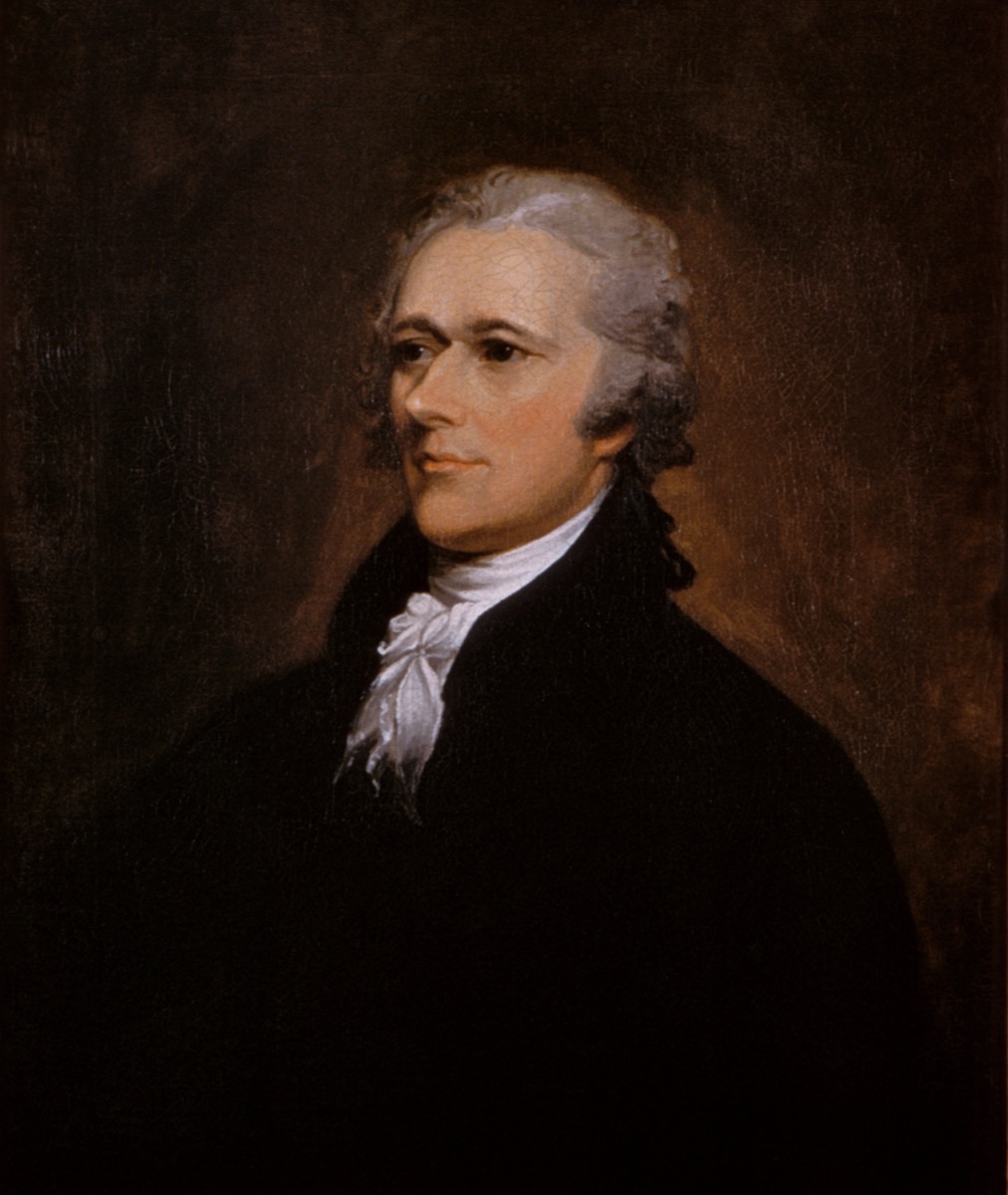
Hamilton's report
On 14 January 1790, Hamilton sent his First Report on Public Credit to the House of Representatives. It was long — roughly forty thousand words — and remarkably blunt. The report rested on three interlocking proposals.
Fund the federal debt at par. Exchange the old, depreciated Continental paper for new federal 6 percent bonds, backed by earmarked customs revenue. Do not ask whether the current holders were the original creditors or speculators who had bought cheap; honor the paper at face value regardless.
Assume the state war debts. Fold the roughly $25 million of state obligations into the federal pile, so that every public debt contracted for the Revolution was a debt of the United States as such.
Charter a national bank. Modeled loosely on the Bank of England — founded in 1694 to finance William III's war against Louis XIV — the new Bank of the United States would hold federal deposits, issue a stable paper currency, and serve as fiscal agent for the Treasury. Readers can see the English template Hamilton drew on in detail in The Bank of England: How Government Debt Created the World's First Central Bank (1694).
Running through all three proposals was a philosophical claim that has shocked readers ever since. "A national debt," Hamilton wrote, "if it is not excessive, will be to us a national blessing." Not because debt was good in itself, but because a permanent, well-funded, regularly serviced public debt would create an instrument that merchants, banks, and foreign investors could hold with confidence. Such an instrument could then circulate almost as money, expand the stock of capital available in the country, and bind wealthy creditors to the fortunes of the federal union.
The speculation problem
Hamilton's funding-at-par proposal immediately ran into a moral objection that would shape American politics for the next decade. By 1789, speculators — mostly in New York, Philadelphia, and Boston — had sent agents into the countryside to buy up old Continental securities from veterans, widows and farmers at fifteen to twenty-five cents on the dollar. Some of these buyers had better information about what Hamilton was planning than the sellers did. James Madison, still Hamilton's ally but increasingly uneasy, proposed a compromise: pay current holders only the market price they had paid, and send the difference to the original holders. It would be, he argued, a discrimination between honest patriot creditors and predatory latecomers.
Hamilton refused. Any such distinction, he argued, would destroy the very thing he was trying to build: a market in which public paper could be bought and sold with the certainty that the government would honor whatever piece of paper showed up at its window. You cannot build a bond market on a government that tries to police the motives of its bondholders. Madison's amendment was defeated 36 to 13 in the House. It was the first sign that the old Revolutionary coalition was splitting (Chernow, 2004).
Madison, Virginia, and the Southern veto
A much larger obstacle was the assumption of state debts. Virginia, Madison's home, had levied heavy taxes in the 1780s and retired much of its own war debt. To its delegation, assumption looked like a straightforward wealth transfer: Virginia taxpayers would now pay federal taxes to cover obligations incurred by Massachusetts and South Carolina. Maryland and Georgia reasoned similarly. When the assumption bill came to a vote in the House in April 1790, it lost narrowly, 31 to 29. Hamilton's program, for a brief moment, seemed dead.
At the same moment Congress was struggling with an apparently unrelated question: where to put the permanent capital of the country. The temporary seat was in New York. Philadelphia wanted the honor. Southerners, determined that the capital not become a New England outpost, were pushing for a site on the Potomac. The two issues — assumption and the capital — had nothing logical to do with each other. They had everything political to do with each other.
The dinner at Maiden Lane
Exactly what was said over dinner at Jefferson's rented house on Maiden Lane in late June 1790 is impossible to reconstruct. Our main source is a memorandum Jefferson wrote years later, and later historians have noted that Jefferson had reasons to minimize his own role (Elkins and McKitrick, 1993). What is clear is the outcome.
Jefferson had found Hamilton on the steps of Washington's house, distraught, convinced that the failure of assumption would break up the union. Jefferson offered to host a dinner with Madison. Over that dinner, the three men arrived at a bargain. Madison would not personally vote for assumption, but he would stop whipping the Virginia delegation against it, and two Potomac-area representatives — Alexander White and Richard Bland Lee — would switch their votes. In exchange, Hamilton would deliver Pennsylvania and New York votes for a permanent capital on the Potomac, with a ten-year interim residence in Philadelphia.
Both halves passed Congress within weeks. The Residence Act, authorizing the new federal district on the Potomac, was signed on 16 July 1790. The Funding Act, including the assumption of state debts, was signed on 4 August 1790. For the price of moving the capital to a tidal marsh seventy miles up the Potomac from Chesapeake Bay, Hamilton had secured the fiscal architecture of the United States.
The market response
The response of investors was swift and unambiguous. In the first months of 1790, as Hamilton's plan was taking shape, federal 6 percent stock had traded at roughly 25 cents on the dollar. By mid-1791, after funding and assumption were law and after the Bank of the United States had been chartered, the same stock was changing hands above par — briefly reaching 125 cents on the dollar in early 1792. Foreign investors, especially in Amsterdam and London, became enthusiastic buyers. By 1803, foreigners held roughly 56 percent of the outstanding federal debt (Sylla, Wilson and Wright, 2006).
Behind the price chart sat something more important: a functioning secondary market. Brokers in New York, Philadelphia and Boston posted daily prices for federal 6s, deferred 6s, and 3 percent stock. Newspapers began to print quotations. A group of twenty-four brokers gathered in May 1792 under a buttonwood tree on Wall Street and signed an agreement to trade securities among themselves on fixed commissions — the origin of what would become the New York Stock Exchange. None of this would have existed without Hamilton's assumption.
Panic, and the first central bank intervention
The boom did not last without incident. In early 1792, a former assistant secretary of the Treasury named William Duer — Hamilton's own former deputy — tried to corner the market in federal 6s and in subscription rights to the new Bank of the United States. Duer borrowed from everyone who would lend: merchants, widows, even prostitutes. When his positions failed in March 1792, federal bond prices collapsed from around 125 to roughly 90 in a matter of weeks. Duer was jailed for debt. Philadelphia and New York credit markets froze.
Hamilton did not let the panic run its course. Working with the Sinking Fund commissioners — a body created to retire federal debt gradually — he authorized open-market purchases of federal securities at specified support prices, spending several hundred thousand dollars to absorb forced sales. He privately urged the Bank of New York and sympathetic correspondents to discount commercial paper for solvent merchants, keeping credit flowing to firms that had nothing to do with Duer's scheme. Within weeks, prices stabilized. Richard Sylla has argued that this was, in substance, the first central bank–style intervention in American history — an open-market operation conducted by the Treasury itself in defense of the fledgling bond market (Sylla, 2011). The precedent was small, improvised, and almost forgotten, but it anticipated by more than a century the instruments of modern central banking, instruments formalized only with the founding of the Federal Reserve in 1913.
The Bank of the United States
The third leg of the program was the national bank. Hamilton's Report on a National Bank, delivered to Congress in December 1790, proposed a privately owned but federally chartered corporation capitalized at $10 million, with the federal government as a minority shareholder. Jefferson and Edmund Randolph advised Washington that the Constitution contained no explicit power to charter corporations, and the bank was therefore unconstitutional. Hamilton responded with his Opinion on the Constitutionality of a National Bank, introducing the doctrine of implied powers: the federal government could exercise powers not listed in the Constitution if they were necessary and proper to carry out listed ones. Washington, after hesitation, sided with Hamilton. The Bank of the United States was chartered for twenty years on 25 February 1791.
The bank began business in Philadelphia in December 1791. Its stock was wildly oversubscribed, sparking a speculative frenzy in Bank scrip that contributed to the tensions Duer later exploited. But once settled, the bank proved its worth. It held federal deposits, handled tax receipts, acted as a fiscal agent for the Treasury, and disciplined state banks by presenting their notes for redemption. For twenty years, until its charter lapsed in 1811, it was the closest thing the young republic had to a central bank.
A credible republic
The deeper significance of 1790 was not the arithmetic of the debt. It was credibility. Before Hamilton, a sovereign republic was widely assumed to be a contradiction in financial terms: without a king, there could be no personal honor binding the state to its creditors, and without that honor there could be no serious bond market. The English had partly solved this after 1688 by yoking the Crown's debts to a parliament accountable to its wealthy citizens. Hamilton's solution was to do the same for a new kind of state, one that had no monarch to begin with.
By 1795 the yield on US 6 percent stock had fallen to around 6 percent — that is, it traded roughly at par — making the young republic's borrowing cost comparable with that of the Bank of England itself. By 1800 the federal government could borrow internationally at rates close to those of the most creditworthy European powers. In Sylla's phrase, the United States had completed a "financial revolution" in barely a decade, far faster than the English equivalent had taken after 1688 (Sylla, 2011).
The political price was high. The alliance between Hamilton and Madison, which had produced the Constitution and the Federalist Papers, shattered over funding and the national bank. Madison and Jefferson organized what became the Democratic-Republican opposition. The party system that would dominate American politics for the next two centuries was born, in no small part, in the resistance to Hamilton's financial program. Even so, every successor — Jeffersonian, Jacksonian, Lincolnian, Rooseveltian — inherited the Hamiltonian architecture of a funded federal debt, a secondary market in Treasury securities, and a federal government whose credit stood on its own feet.
It is still standing. The modern global financial system runs on United States Treasury securities as its benchmark safe asset. Central banks from Tokyo to Frankfurt hold trillions of dollars of them as reserves. Every time an investor, anywhere in the world, quotes a spread over "Treasuries," they are quoting off an instrument whose lineage runs directly back to a dinner in a rented Manhattan townhouse in June 1790 — and to the stubborn conviction of a Caribbean-born immigrant that a republic could, if it kept faith with its creditors, borrow as well as any king.
Related
Historical records Learn more about our methodology.